Best Hospital in Ghatkopar, Mumbai | Zynova Shalby Hospital


Small Cell vs Non-Small Cell Lung Cancer: Key Differences
- Home
- Small Cell vs Non-Small Cell Lung Cancer: Types, Differences and Treatment Options
- admin
- 0 Comments
When a doctor says “lung cancer”, the next question is almost always “which type?” Everything after that depends on the answer: the tests you need, the treatment you are offered, and how fast decisions have to be made.
There are two main kinds. Small cell lung cancer and non small cell lung cancer look different under a microscope, grow at different speeds and respond to different treatments. This guide explains small cell vs non small cell lung cancer in plain language, covering symptoms, stages, diagnosis and treatment. If you want the wider picture first, our article on lung cancer in India is a good place to start.
What Is Lung Cancer?
Lung cancer begins when cells in the lung change and start multiplying without the usual controls. They can form a lump, press on nearby airways and blood vessels, and sometimes spread through the lymph nodes or bloodstream to other organs.
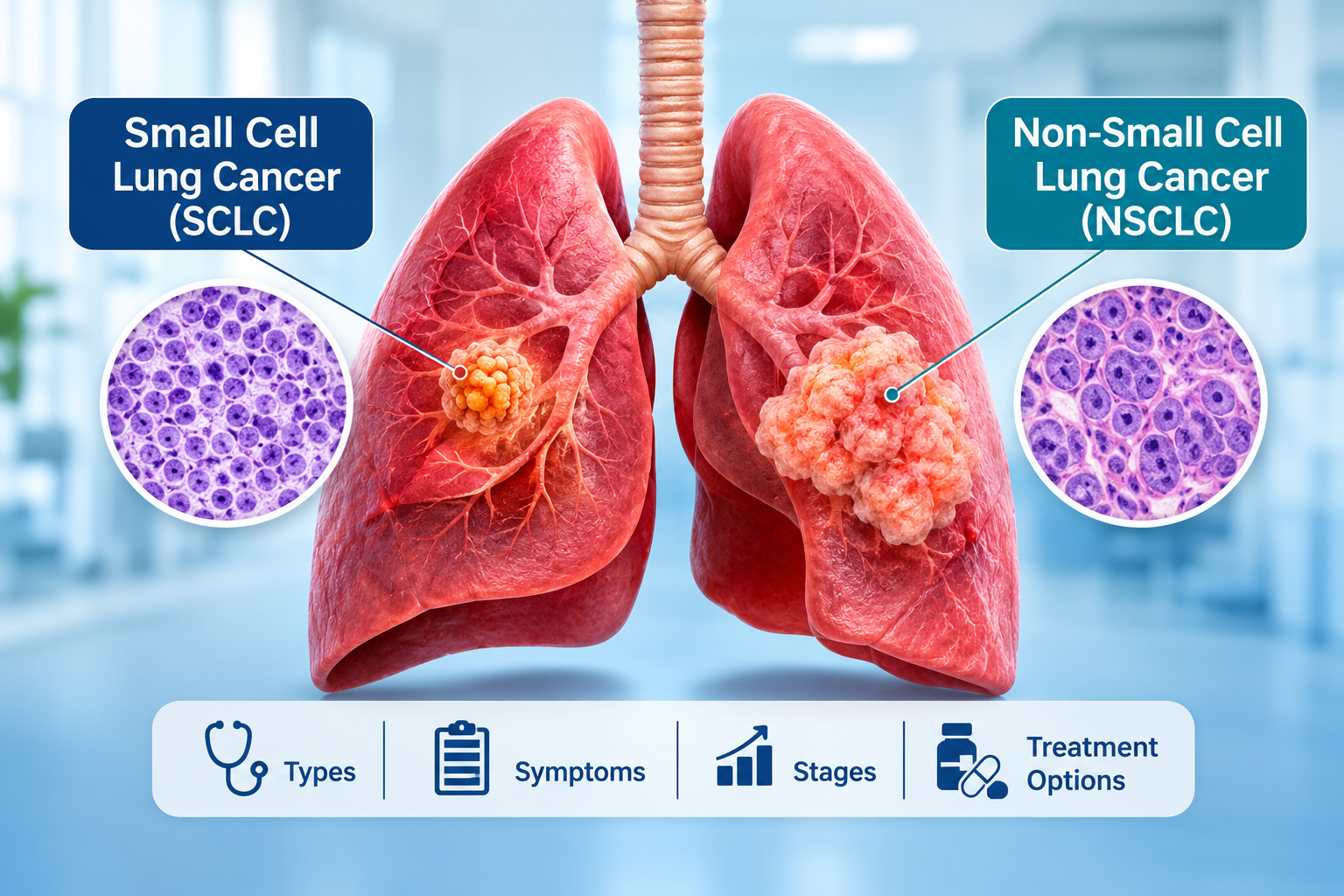
Doctors sort the types of lung cancer by what the cells look like. That gives two groups: small cell lung cancer (SCLC), about 10 to 15 percent of cases, and non-small cell lung cancer (NSCLC), about 80 to 85 percent.
Knowing the group is not a formality. It decides whether surgery is realistic, whether a tablet-based targeted treatment could work, and whether treatment needs to begin within days.
What Is Small Cell Lung Cancer (SCLC)?
Small cell lung cancer takes its name from the small, round cells a pathologist sees in the sample. You may also hear it called oat cell carcinoma. It usually starts in the large airways near the centre of the chest.
How fast does SCLC grow and spread?
Fast. SCLC cells divide quickly and often travel early to lymph nodes, the liver, bones, adrenal glands and brain. Many people already have spread beyond the chest by the time it is found.
The upside of that fast growth is that SCLC often responds well to chemotherapy and radiation at first. The difficulty is that it can come back, so follow-up matters.
Key features of SCLC
- It is very strongly linked to tobacco and is uncommon in people who have never smoked.
- It is a neuroendocrine cancer, so it can sometimes upset hormone and salt levels.
- A rarer form, combined small cell lung cancer, contains both small cell and non-small cell areas.
- Surgery is used only in a small number of very early cases.
What Is Non-Small Cell Lung Cancer (NSCLC)?
Non small cell lung cancer is a group, not a single disease. It covers every lung cancer that is not small cell. As a rule it grows more slowly than SCLC, and more cases are found while still inside the chest, which keeps more treatment options open.
Adenocarcinoma
The most common subtype. It usually starts in the outer part of the lung and is the type most often seen in lung cancer in non-smokers, including many patients in India.
Squamous cell carcinoma
Usually begins in the central airways and has a strong link with smoking.
Large cell carcinoma
The least common subtype. It is often diagnosed by exclusion, meaning other types are ruled out first. A confident diagnosis generally needs a larger tissue sample than a small biopsy provides.
Key features of NSCLC
- Tumour cells may carry gene changes such as EGFR or ALK, which can be treated with targeted medicines.
- Surgery is a central option in early stages.
- The range of NSCLC treatment options is wider than for SCLC and includes immunotherapy and targeted therapy.
Small Cell vs Non-Small Cell Lung Cancer: Key Differences
This is the difference between SCLC and NSCLC at a glance.
Feature | Small Cell Lung Cancer (SCLC) | Non-Small Cell Lung Cancer (NSCLC) |
Share of lung cancers | About 10 to 15 percent | About 80 to 85 percent |
Cell characteristics | Small, round cells | Larger cells; adenocarcinoma, squamous cell and large cell subtypes |
Growth and spread | Fast; often spreads early | Usually slower; varies by subtype and stage |
Link with smoking | Very strong | Strong in squamous cell; adenocarcinoma also occurs in non-smokers |
Common symptoms | Cough, breathlessness, chest pain, weight loss; sometimes facial swelling or hormone-related symptoms | Cough, coughing up blood, chest pain, breathlessness, hoarseness, weight loss |
Diagnosis | Biopsy and pathology; imaging for spread | Biopsy and pathology, plus biomarker testing |
Staging | Limited stage or extensive stage | Stage I to IV |
Main treatment | Chemotherapy with immunotherapy; radiation | Surgery, radiation, chemotherapy, immunotherapy, targeted therapy |
Role of surgery | Rare; very early disease only | Central in early-stage disease |
Targeted therapy | Limited at present | Important, especially in adenocarcinoma |
What the table means in real life
The biggest gap is behaviour. SCLC moves quickly and is often found after it has spread, so treatment usually works through the whole body. NSCLC is more varied. An early NSCLC may be removed or treated with focused radiation, while an advanced one may be controlled for a long time with targeted or immune-based medicines.
People often ask which is “worse”. SCLC is generally the more aggressive of the two. But outcomes for both depend heavily on the stage at diagnosis, general health and how the cancer responds, so a population statistic says little about one person.
Symptoms of Small Cell and Non-Small Cell Lung Cancer
Early lung cancer can be silent. When lung cancer symptoms do appear, they overlap a lot between the two types:
- A cough that will not go away, or a long-standing cough that changes
- Coughing up blood or rust-coloured sputum
- Chest pain, often worse with deep breaths or coughing
- Breathlessness or wheezing
- Hoarseness
- Unexplained weight loss and tiredness
- Chest infections that keep returning
If the cancer has spread, you may also see bone pain, headaches, weakness or yellowing of the skin.
Where the symptoms differ
Small cell lung cancer symptoms can include swelling of the face and neck, because a central tumour may press on a large vein. Hormone-related effects, such as muscle weakness or confusion from low blood sodium, are also more typical of SCLC.
Non small cell lung cancer symptoms may stay quiet for longer, especially in adenocarcinoma growing in the outer lung. Problems often show up when it reaches the lining of the lung or spreads.
None of these symptoms proves cancer. Infections, asthma and tuberculosis cause many of them. If they persist, a review with a pulmonologist in Ghatkopar is a sensible first step.
Stages of Small Cell and Non-Small Cell Lung Cancer
Staging describes how far the cancer has travelled. It is the single biggest guide to treatment, which is why lung cancer types and stages are always discussed together.
Small cell lung cancer stages
- Limited stage: The cancer is on one side of the chest and can be covered by one radiation area. About one in three patients are diagnosed here.
- Extensive stage: The cancer has reached the other lung, distant lymph nodes or other organs. About two in three patients are diagnosed here.
Non small cell lung cancer stages
- Stage I: A small tumour within the lung, no lymph node spread.
- Stage II: A larger tumour, or spread to nearby lymph nodes.
- Stage III: Spread to lymph nodes in the centre of the chest or to nearby structures. It is divided into IIIA, IIIB and IIIC.
- Stage IV: Spread to the other lung, to fluid around the lung or heart, or to distant organs.
How staging shapes treatment
Staging tells doctors whether the aim is to remove or destroy the cancer, or to control it over time. A stage I NSCLC and a stage IV NSCLC are both “non-small cell”, yet their treatment plans look completely different.
How Are SCLC and NSCLC Diagnosed?
Lung cancer diagnosis combines scans, a tissue sample and laboratory tests.
- Chest X-ray: Often the first step. It can show a shadow but cannot confirm cancer, and it can miss small tumours.
- CT scan: Shows the tumour, lymph nodes and surrounding structures in detail. You can read about imaging in radiology at the hospital.
- PET-CT scan: Highlights areas of high activity and helps check for spread across the body.
- MRI: Commonly used to look at the brain, where both types can spread.
- Bronchoscopy: A thin camera is passed into the airways to see the tumour and take samples. A related technique uses ultrasound to sample chest lymph nodes.
- Lung biopsy: A small piece of tissue is taken, sometimes through the skin under CT guidance, which falls under interventional radiology. Fluid around the lung may also be tested.
- Histopathology: A pathologist examines the sample to confirm cancer, decide small cell versus non-small cell and identify the NSCLC subtype. This work is done in pathology.
- Molecular and biomarker testing: Mainly for NSCLC. It looks for changes such as EGFR, ALK, ROS1, BRAF, KRAS, MET, RET and NTRK, and measures PD-L1, a protein that helps predict response to immunotherapy.
Biomarker results can change the plan. In advanced NSCLC, doctors usually wait for them before starting immunotherapy, because a targeted tablet may suit the patient better. A blood-based “liquid biopsy” can add information but does not always replace testing the tumour tissue.
What about lung cancer screening?
A low dose CT scan can find small nodules before symptoms start. It is not for everyone and is usually considered for people at high risk, such as long-term smokers, after a discussion with a doctor. If you are unsure whether you qualify, ask about it at a health checkup.
Small Cell Lung Cancer Treatment Options
Small cell lung cancer treatment depends mainly on whether the disease is limited or extensive, and on how fit the patient is.
Limited-stage SCLC
The standard approach is chemotherapy given together with radiation to the chest. If the cancer has not progressed afterwards, immunotherapy with durvalumab may follow. Doctors may also discuss preventive brain radiation or regular brain scans, since SCLC can spread to the brain. In rare, very early cases, surgery may be considered.
Extensive-stage SCLC
Treatment is usually chemotherapy plus immunotherapy (atezolizumab or durvalumab), followed by maintenance immunotherapy. In some patients, a chemotherapy drug called lurbinectedin is added to the maintenance phase. If the cancer returns after platinum-based chemotherapy, a newer immunotherapy called tarlatamab may be an option. Radiation can relieve symptoms or treat spread to the brain or bones.
SCLC often shrinks well early on but may return, so these SCLC treatment options are paired with close follow-up and supportive care. Chemotherapy sessions can often be given through a chemotherapy daycare unit, so many patients go home the same day.
Non-Small Cell Lung Cancer Treatment Options
Non small cell lung cancer treatment is built around stage, subtype, biomarkers and health. Doctors often combine approaches.
Surgery
The main treatment for stage I and II and for selected stage III disease. The operation may remove a small wedge, a segment, a full lobe or, less often, a whole lung. If surgery is not suitable, focused radiation can be an alternative.
Chemotherapy
May be given before surgery, after surgery or as part of treatment for advanced cancer.
Radiation therapy
Used alone for early tumours when surgery is not an option, with chemotherapy for locally advanced disease, and to ease symptoms in advanced disease.
Immunotherapy
Helps the immune system recognise and attack cancer cells. It may be given before or after surgery, after chemoradiation, or as main treatment in advanced disease, depending on PD-L1 and other factors. It is not suitable for everyone, for example some people with autoimmune disease or certain gene changes.
Targeted therapy
When the tumour carries a driver change such as an EGFR mutation or ALK rearrangement, a targeted tablet may be used. It can be given after surgery, after chemoradiation in selected stage III cases, or as first treatment in advanced disease.
Combination treatment
Many plans mix these. Examples include chemotherapy with immunotherapy before surgery, or chemoradiation followed by durvalumab or, in selected EGFR-positive patients, osimertinib.
How Do Doctors Decide the Right Lung Cancer Treatment?
There is no standard plan that fits everyone. Doctors weigh:
- Type and subtype: small cell, adenocarcinoma, squamous cell or other
- Stage: how far the cancer has spread
- Tumour details: size, position and nearby structures
- Biomarkers: EGFR, ALK, PD-L1 and others in NSCLC
- General health: heart and lung function, other illnesses, fitness for surgery or radiation
- Your priorities: the goal of treatment, side effects you can live with, daily life
These choices are usually made by a team: a medical oncologist, radiation oncologist, thoracic surgeon, pulmonologist, radiologist and pathologist, often at a tumour board meeting.
When Should You Consult a Lung Cancer Specialist?
Book a review if you notice any of these for more than about three weeks:
- A new cough, or an old cough that changes
- Blood in your sputum
- Ongoing chest pain or breathlessness
- Weight loss you cannot explain
- Hoarseness that does not settle
- Repeated chest infections
In India, lung symptoms are often treated first as a chest infection or tuberculosis. If symptoms continue despite treatment, or a scan shows a shadow that does not clear, ask whether cancer has been looked for. Earlier assessment usually means more options.
Current and former smokers, people exposed to polluted air, cooking-fuel smoke, asbestos or radon, and anyone with a family history should be especially watchful. Lung cancer also happens in people who have never smoked. To find a lung cancer specialist in Mumbai, you can browse the doctors page or book an appointment directly.
Lung Cancer Treatment in Mumbai
If you are searching for lung cancer treatment in Mumbai, the first things to get right are the diagnosis, the stage and, for NSCLC, the biomarker report. Treatment choices follow from those, not the other way round.
The oncology department at Zynova Shalby Hospital in Ghatkopar lists medical oncology, surgical oncology, radiation therapy, chemotherapy daycare, immunotherapy and targeted therapy, and describes a tumour board review for each case. Details are on the oncology hospital in Ghatkopar page. If you live in the eastern suburbs, this is also convenient for lung cancer treatment in Ghatkopar and nearby areas. The hospital is on LBS Marg, Ghatkopar West.
Some questions worth asking at any consultation:
- What type and stage is my lung cancer?
- Have biomarker tests been done, and what do they show?
- Is the goal to cure the cancer or control it?
- What side effects should I expect, and how will they be managed?
- Which tests are done in house and which are sent out?
A second opinion is a normal part of cancer care. A good team will not mind it.
Consult Dr. Prriya Eshpuniyani for Lung Cancer Care
If you or a family member has been told to get a lung cancer evaluation, speaking to an experienced specialist early can make the next steps clearer. At Zynova Shalby Hospital, Ghatkopar, you can consult Dr. Prriya Eshpuniyani for guidance on lung cancer diagnosis and treatment planning.
During a consultation, Dr. Prriya Eshpuniyani can help you understand:
- Whether your reports point to small cell or non-small cell lung cancer
- What stage the cancer is at and what that means for treatment
- Which tests, such as biomarker testing for NSCLC, may be needed
- Which treatment options are suitable for your situation
Bring your previous scans, biopsy reports and prescriptions to the appointment, as they help the doctor review your case properly. To book a consultation, call 022-68900000 or use the appointment page on the Zynova Shalby Hospital website.
Frequently Asked Questions About Small Cell and Non-Small Cell Lung Cancer
What is the main difference between small cell and non-small cell lung cancer?
The cells look different and behave differently. SCLC grows and spreads faster. NSCLC usually grows more slowly and has more treatment options.
Which grows faster, SCLC or NSCLC?
SCLC generally grows faster and spreads earlier. NSCLC varies with subtype and stage.
What are the early symptoms of small cell lung cancer?
A cough that lingers, breathlessness or chest discomfort. Because SCLC can spread early, some people notice symptoms only after it has spread.
What are the common symptoms of non-small cell lung cancer?
A long-lasting cough, coughing up blood, chest pain, breathlessness, hoarseness and weight loss. Early NSCLC may cause no symptoms at all.
What are the stages of small cell lung cancer?
Limited stage and extensive stage. Doctors may also assign a TNM stage.
What are the stages of non-small cell lung cancer?
Stage I to IV, based on tumour size, lymph node involvement and spread to other organs.
Can non-small cell lung cancer be treated with surgery?
Yes, especially in stage I and II and selected stage III cases. Suitability depends on the tumour, lung function and general health.
What are the treatment options for small cell lung cancer?
Chemotherapy, radiation and immunotherapy. Surgery is rarely used and only in very early disease.
Is chemotherapy used for both SCLC and NSCLC?
Yes. It is central in SCLC and part of many NSCLC plans, often with radiation or immunotherapy.
Can non-smokers get lung cancer?
Yes. Air pollution, cooking smoke, secondhand smoke, radon, asbestos and gene changes can all play a part. Adenocarcinoma is the most common type in never-smokers.
Can NSCLC turn into SCLC?
Occasionally, usually after targeted therapy. It is uncommon, and doctors may repeat a biopsy if the cancer starts behaving differently.
Why does identifying the type of lung cancer matter?
It decides which tests are needed, which treatments are likely to work and whether surgery or targeted therapy is possible. If you have questions about your own reports, you can contact the hospital or call 022-68900000.
Leave a Comment