Best Hospital in Ghatkopar, Mumbai | Zynova Shalby Hospital


Kidney Stone Treatment: Symptoms, Causes & Surgery | Zynova Shalby
- Home
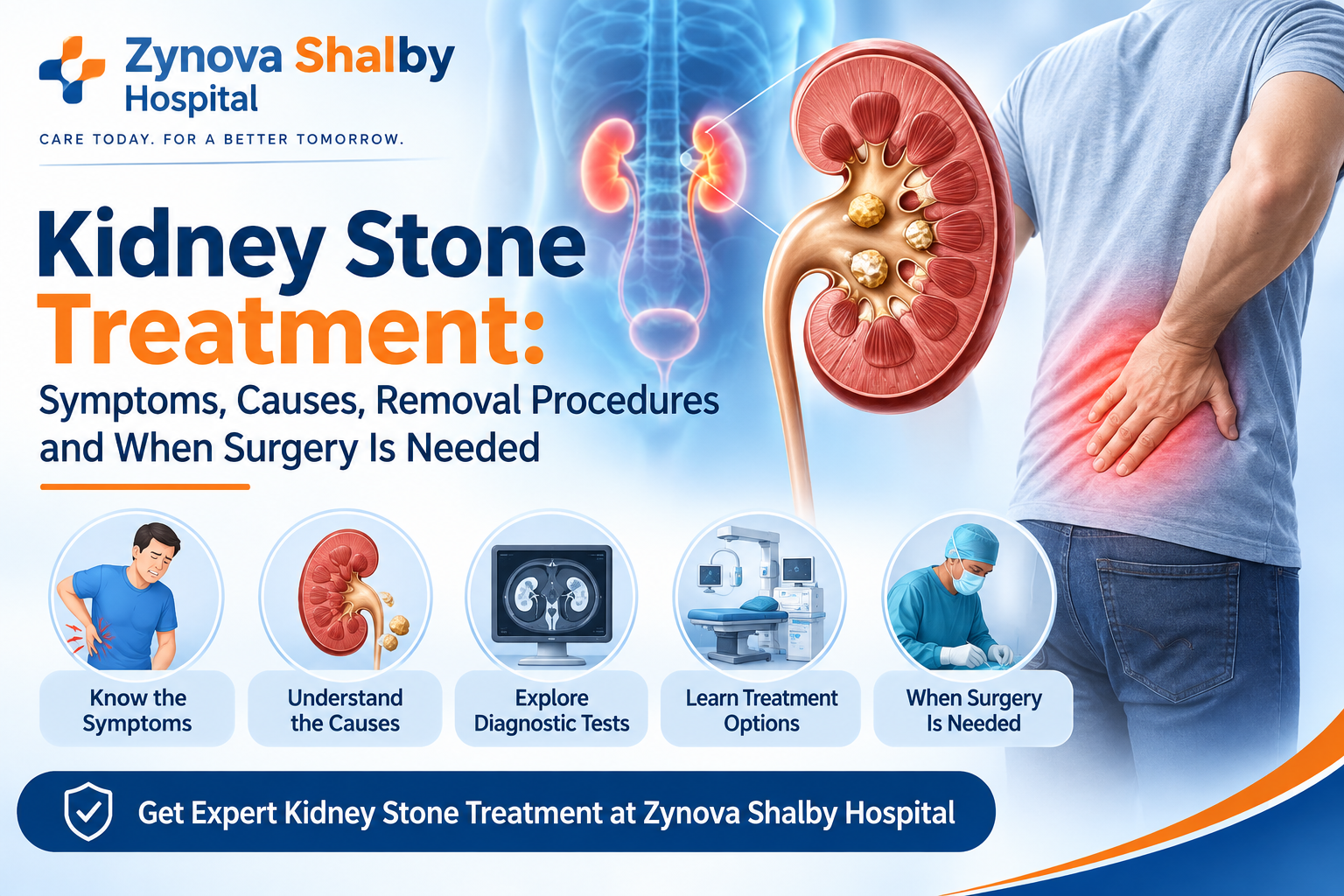
- Kidney Stone Treatment: Symptoms, Causes, Removal Procedures and When Surgery Is Needed
- admin
- 0 Comments
A sudden cramping pain in your back or side that rises and falls in waves is hard to ignore. When it comes with blood in the urine, burning while passing urine or nausea, a kidney stone is a likely cause. The question most people ask next is simple: will I need an operation?
Often, the answer is no. Kidney stone treatment ranges from fluids and pain control for small stones to laser procedures, shock wave lithotripsy and, for large or complicated stones, surgery. What decides the route is the stone’s size and position, whether it blocks the flow of urine, whether there is infection, and how well your kidney is working.
This guide covers kidney stone symptoms, causes, tests, every major treatment option and the situations where surgery is the safer choice. If you are looking for kidney stone treatment at Zynova Shalby Hospital, the local care and booking details are near the end.
Quick answer: Stones smaller than about 5 mm often pass on their own with fluids, pain relief and monitoring. Larger stones, stones that block the urinary tract and stones with infection usually need a procedure such as lithotripsy, ureteroscopy with laser, RIRS or PCNL. Severe pain with fever or chills is an emergency.
What Are Kidney Stones?
Kidney stones are hard deposits of minerals and salts that form inside the kidney when urine becomes too concentrated. Doctors also call the condition urolithiasis or nephrolithiasis. A stone can be as small as a grain of sand or large enough to fill part of the kidney.
A stone that stays inside the kidney often causes no pain. Trouble starts when it moves into the ureter, the narrow tube that carries urine from the kidney to the bladder. The stone can block urine flow, and the kidney stretches as pressure builds behind it. That pressure is what causes the severe pain.
Kidney Stone Symptoms
Symptoms depend on the stone’s size and where it sits. The most common ones are:
- Sharp pain in the back, side, lower abdomen or groin that comes and goes in waves
- Pain that moves downward toward the groin as the stone travels
- Pink, red or brown urine (blood in the urine)
- Burning or pain while passing urine, a frequent or urgent need to go, or pelvic pressure, especially when the stone is close to the bladder
- Nausea and vomiting
- Cloudy or foul-smelling urine
- Fever and chills, which can signal infection
Stone pain is often described as restless pain. People cannot find a comfortable position, unlike a pulled back muscle that eases when you shift or rest.
Some stones cause no symptoms at all and are found on a scan done for another reason. Even then, they are worth discussing with a urologist, because a silent stone can start to move or grow later.
Kidney Stone Causes and Risk Factors
Stones form when urine carries more crystal-forming substances, such as calcium, oxalate and uric acid, than the available fluid can keep dissolved. Several things tip that balance:
- Drinking too little water, or losing a lot of fluid through sweat in hot, humid weather
- A diet high in salt, animal protein or sugar
- A personal or family history of kidney stones
- Obesity and diabetes
- Gout or high uric acid levels
- An overactive parathyroid gland (hyperparathyroidism)
- Repeated urinary tract infections
- Certain medicines, including some diuretics, anti-seizure drugs and antacids
- Inherited conditions such as cystinuria
Types of Kidney Stones
The type of stone shapes both treatment and prevention, which is why a stone that has passed should be saved for analysis.
Stone type | Usual background | Useful to know |
Calcium oxalate and calcium phosphate | Low fluid intake, high calcium or oxalate in urine | Together these make up most stones |
Uric acid | Acidic urine, gout, high-protein diet | Some can be dissolved with medicine that makes urine less acidic |
Struvite | Linked to urinary tract infections | Can grow quickly into large, branched stones |
Cystine | Inherited, rare | Tends to come back, so long-term follow-up matters |
How Kidney Stones Are Diagnosed
A urologist begins with your symptoms, medical history and a physical examination. Tests then confirm the stone and show whether it is causing a blockage or infection.
- Urine test: looks for blood, infection and crystals.
- Blood tests: check kidney function, calcium and uric acid.
- Ultrasound: uses no radiation and can show a stone in the kidney and swelling caused by blockage. It may miss small stones in the ureter. It is often preferred in pregnancy.
- Non-contrast CT scan: usually the most accurate test for a stone’s size and exact position.
- X-ray of the abdomen: sometimes used to track certain stones over time.
Whether the stone is blocking urine flow often matters more for treatment than the stone’s size alone.
How Stone Size and Location Affect Kidney Stone Treatment
Size and position are the two facts that guide most decisions. The ranges below follow commonly used international urology guidance and are a general map, not a prescription. Your urologist may choose differently based on your scan and health.
Situation | What it usually means |
Ureter stone under about 5 mm, no infection, pain controlled | Most pass on their own. Observation with fluids and pain relief is common. |
Ureter stone of 5 to 10 mm | Roughly half pass. Doctors may observe for a limited time, offer medicine, and intervene if it does not move. |
Ureter stone over 10 mm | Unlikely to pass. A procedure is usually needed. |
Kidney stone up to about 20 mm | Shock wave lithotripsy or ureteroscopy with laser (including RIRS) are the usual options. |
Kidney stone over 20 mm, or a complex stone | PCNL is generally the first choice. |
Any stone with infection or blockage | Urgent drainage and treatment, whatever the size. |
Location matters too. Stones in the lower part of the ureter, near the bladder, pass more readily than stones higher up. In the kidney, larger stones in the lower pole respond less well to shock waves. Very dense stones also resist shock waves. Pregnancy, blood thinners, bleeding disorders, a single working kidney and body build can all change which procedure is safest.
Kidney Stone Treatment Without Surgery
Yes, kidney stone treatment without surgery is possible when the stone is small, pain is controlled, and there is no infection or blockage that threatens the kidney.
Waiting for the Stone to Pass
For uncomplicated stones under 10 mm, doctors often advise a period of observation. Most small stones pass within a few weeks, and treatment is usually reconsidered if a stone has not passed after about four to six weeks. During this time:
- Drink enough fluids unless a doctor has restricted them because of heart, kidney or liver disease.
- Strain your urine and keep any stone that passes so it can be analysed.
- Keep follow-up appointments and repeat imaging as advised.
Medicines
Pain relief is the foundation. Anti-inflammatory painkillers are commonly used, but people with kidney disease, stomach ulcers or those on blood thinners should take them only on medical advice. Anti-nausea medicine may be added.
Some doctors prescribe an alpha blocker such as tamsulosin to relax the ureter. The evidence for it is mixed, so it is decided case by case. Certain uric acid stones can also be treated with medicine that makes urine less acidic.
What Not to Rely On
No herbal drink, juice or home remedy replaces a proper assessment. Waiting too long with an infected or blocked kidney can damage it, so treat any fever with stone pain as urgent.
Kidney Stone Removal Procedures
When a stone will not pass or cannot safely wait, it needs to be broken up or taken out. These procedures sit at different points on the scale from non-invasive to surgical. Zynova Shalby Hospital’s urology team performs kidney stone removal using PCNL, ureteroscopy and Holmium laser lithotripsy, as listed on its urology page.
ESWL (Shock Wave Lithotripsy)
ESWL is the only common option with no incision and no scope. A machine directs shock waves through the skin to the stone, which breaks into fragments that you pass in your urine over the following days to weeks. You receive pain relief or sedation during the session.
This lithotripsy treatment works best for small to moderate stones in a favourable position. It is less effective for very hard stones, large stones and some lower pole stones, and it may need repeat sessions. It is not suitable during pregnancy, with an uncorrected bleeding disorder or with active infection. Passing fragments can cause colicky pain and blood in the urine.
Ureteroscopy With Laser Lithotripsy
In ureteroscopy, a thin scope travels up through the urethra and bladder into the ureter. There is no cut on the body. Once the surgeon sees the stone, a laser fibre passed through the scope breaks it up. Fragments are either removed with a tiny basket or left as fine dust to pass naturally. Anaesthesia is needed, and a temporary stent is often placed afterwards.
This clears up a common confusion about laser treatment for kidney stones. The laser is not an outside beam. It is delivered inside the body through a scope, and the same laser is also used during RIRS and PCNL.
RIRS Surgery (Retrograde Intrarenal Surgery)
RIRS is ureteroscopy with a flexible scope that bends to reach the inner chambers of the kidney. The route is the same as ureteroscopy, so there is no incision. The surgeon fragments the stone with laser and removes the pieces.
Despite the word surgery, RIRS is minimally invasive. It is commonly used for small to moderate kidney stones, including some that shock waves treat poorly. Very large stones may need more than one session or a different approach.
PCNL (Percutaneous Nephrolithotomy)
PCNL is the most involved of the four. The surgeon makes a small cut in the back and creates a narrow tunnel into the kidney under imaging guidance. A scope passed through the tunnel lets the surgeon break up and remove the stone directly. General anaesthesia and a hospital stay are needed.
PCNL is generally preferred for stones larger than about 2 cm, complex or branched stones, and stones that other methods have not cleared. It clears large stones more reliably than other options but carries more risk, such as bleeding, which is why it is kept for the cases that need it. Smaller-tunnel versions, often called mini PCNL, exist, and your surgeon will explain which suits your stone.
Ureteric Stent
A stent is a thin, soft tube placed in the ureter to keep it open or to drain a blocked kidney. It is temporary. Stents can cause urgency, flank discomfort and blood-tinged urine until removed, and they must be taken out or exchanged on schedule rather than forgotten.
Procedures Compared
Procedure | Type | How it reaches the stone | Usually considered for | Points to know |
ESWL | Non-invasive | Shock waves from outside the body | Small to moderate stones in a suitable position | Fragments pass on their own. Repeat sessions are possible. Less suited to hard or lower pole stones. |
Ureteroscopy with laser | Minimally invasive | Rigid or semi-rigid scope up the ureter | Stones in the ureter | A stent is often placed afterwards |
RIRS | Minimally invasive | Flexible scope into the kidney | Small to moderate kidney stones | No incision. Large stones may need staged treatment. |
PCNL | Surgical (through the back) | Tunnel from the back into the kidney | Large, complex or branched stones | Hospital stay. Higher risk than other methods. |
When Is Kidney Stone Surgery Needed?
Not every stone needs an operation, but a procedure is usually advised when:
- The stone is too large to pass, generally over 10 mm in the ureter or a large stone in the kidney
- A stone has not passed after the observation period, often four to six weeks
- Pain or vomiting cannot be controlled with medicine
- There is infection together with a blocked kidney
- Kidney function is at risk, for example with a single kidney, both kidneys blocked or existing kidney disease
- The stone is growing, or is causing repeated infections or bleeding
- Personal circumstances make waiting impractical and you and your doctor agree on earlier treatment
Most modern stone treatment is done through natural passages or small cuts. A kidney stone operation with a large open incision is rarely needed today.
Why Infection With a Blocked Kidney Is an Emergency
An infected kidney that cannot drain can lead to serious illness. Doctors usually relieve the blockage first with a stent or a drain tube placed through the back, treat the infection with antibiotics, and remove the stone later once it is safe.
Recovery After Kidney Stone Removal
Recovery differs by procedure, stone burden and your general health, so your surgeon’s instructions come first. Some things are common across procedures:
- Blood-tinged urine and mild burning for a short period are expected, especially with a stent.
- After ESWL, passing fragments can cause waves of pain for a while.
- PCNL needs a hospital stay and a longer period of limited activity than scope-based procedures.
- Drink fluids as advised and take medicines as prescribed.
- Attend follow-up imaging to confirm the stone is gone, and make sure any stent is removed on time.
Contact your doctor promptly for fever, uncontrolled pain, heavy bleeding with clots, or being unable to pass urine.
How to Prevent Kidney Stones From Coming Back
Treatment removes the stone but not the tendency to form one. Studies commonly put the chance of another stone at roughly one in three to one in two over ten years without prevention, so a plan is worth making.
- Hydrate steadily. Aim for pale urine. Many urologists suggest enough fluid to pass about two to two and a half litres of urine a day, but your target depends on your health, particularly any heart or kidney condition.
- Cut hidden salt. High sodium raises calcium in the urine. Pickles, papads, namkeen and packaged snacks add up quickly.
- Moderate animal protein.
- Keep calcium in your diet. Calcium from food, such as milk and curd, helps prevent stones. Avoid starting calcium supplements without medical advice.
- Match diet to stone type. If you form calcium oxalate stones, your doctor may advise limiting very high oxalate foods rather than cutting whole food groups.
- Manage related conditions such as diabetes, obesity and gout.
- Get tested if stones recur. Stone analysis, blood tests and a 24-hour urine collection can show why you form stones, and medicines may be prescribed to match the findings.
People with repeated stones, reduced kidney function or diabetes may also benefit from seeing a kidney specialist. Zynova Shalby’s nephrology department offers kidney care that includes dietary advice and preventive guidance.
When to See a Urologist
Book a consultation soon if you have suspected stone symptoms for the first time, blood in your urine, flank pain that keeps returning, a known stone that has not passed, or stones that keep coming back. A urologist in Ghatkopar such as Dr. Alap Mehendale, a consultant urologist with DNB Urology training whose listed areas of expertise include endourology for stones, can assess your scan and explain your options.
Seek emergency care straight away if you have:
- Severe pain with fever or chills
- Vomiting that stops you keeping fluids down
- Little or no urine
- Pain that medicine does not control
- A single kidney, or stone pain during pregnancy
Kidney Stone Treatment in Mumbai at Zynova Shalby Hospital
Zynova Shalby Hospital is on LBS Marg, Ghatkopar West, Mumbai 400086, and is listed as open 24 hours. Its urology department lists kidney stones among the conditions it treats, with PCNL, ureteroscopy and Holmium laser lithotripsy named for stone removal. For anyone comparing a kidney stone hospital in Mumbai, a useful step is to ask which procedure your stone calls for and why.
Patients who want a specialist opinion can also read the profile of Dr. Ramesh Mahajan, a consultant urologist with MCh Urology qualification. As a kidney stone specialist in Mumbai, his listed areas of expertise include kidney and urinary tract stone management and endourology. The hospital’s website also mentions cashless facilities and insurance claim support, which is worth asking about when you book.
A first consultation usually involves a review of your symptoms and scans, a few tests, and a plan matched to your stone rather than a default procedure.
Frequently Asked Questions About Kidney Stone Treatment
What are the first symptoms of kidney stones?
Usually sudden pain in the back or side, just below the ribs, that comes in waves. Blood in the urine, nausea or burning while urinating may follow. A stone resting in the kidney can cause no symptoms at all.
Can kidney stones go away without surgery?
Yes, many do. Most stones under 5 mm pass on their own, and about half of those between 5 and 10 mm do. This assumes pain is controlled and there is no infection or blockage. Ureter stones above 10 mm rarely pass.
What size of kidney stone requires surgery?
There is no single cutoff. A ureter stone over 10 mm usually needs a procedure, and a kidney stone over 20 mm is generally treated with PCNL. Smaller stones may also need treatment if they cause infection, blockage, uncontrolled pain or do not pass in four to six weeks.
Is laser treatment effective for kidney stones?
Laser lithotripsy through a ureteroscope is a standard, guideline-supported option for stones in the ureter and many kidney stones, including hard ones. Results depend on stone size, number and position, and a second session is sometimes needed.
What is RIRS surgery?
RIRS, or retrograde intrarenal surgery, uses a thin flexible scope passed through the urethra, bladder and ureter into the kidney. A laser breaks the stone and the fragments are removed. There is no incision, anaesthesia is used, and a temporary stent may be left in.
Is RIRS different from lithotripsy?
Lithotripsy means breaking a stone. ESWL does this with shock waves from outside the body, while RIRS does it from inside with a scope and laser, which is itself a form of laser lithotripsy. ESWL avoids a scope but may need repeat sessions. RIRS gives direct control over fragments but needs anaesthesia. The better choice depends on the stone.
How long does kidney stone removal take?
There is no standard duration. It depends on the stone’s size, number, hardness and position, and on whether a stent or a second session is needed. A small ureter stone is usually quicker than a large kidney stone treated with PCNL. Ask your surgeon for an estimate after reviewing your scan.
When should I consult a urologist for kidney stones?
As soon as you suspect a stone, especially with blood in the urine, pain that keeps returning, a stone seen on a scan, or a stone that has not passed in a few weeks. Fever, vomiting or very little urine with stone pain needs emergency care.
Can kidney stones come back after treatment?
Yes. Commonly cited estimates are about 35% to 50% within ten years without prevention. Steady hydration, less salt, the right diet for your stone type, stone analysis and medicines when advised all lower the risk.
Where can I get kidney stone treatment in Mumbai?
Zynova Shalby Hospital in Ghatkopar West offers urology care for kidney stones, including PCNL, ureteroscopy and Holmium laser lithotripsy, as listed on its urology page. Appointments can be booked on 022-68900000.
Conclusion
The right kidney stone treatment is the one that fits your stone, not the one that sounds most advanced. A small stone may need only fluids and monitoring. A blocked or infected kidney needs prompt action. Between those two ends sit lithotripsy, ureteroscopy, RIRS and PCNL, each suited to different sizes and positions.
If you have symptoms, a scan showing a stone, or a stone that keeps returning, get it assessed early. You can book an appointment at Zynova Shalby Hospital or call 022-68900000 to speak to the team.
Leave a Comment