Best Hospital in Ghatkopar, Mumbai | Zynova Shalby Hospital


Lung Cancer in India: 9 Early Signs, Causes & Treatment
- Home
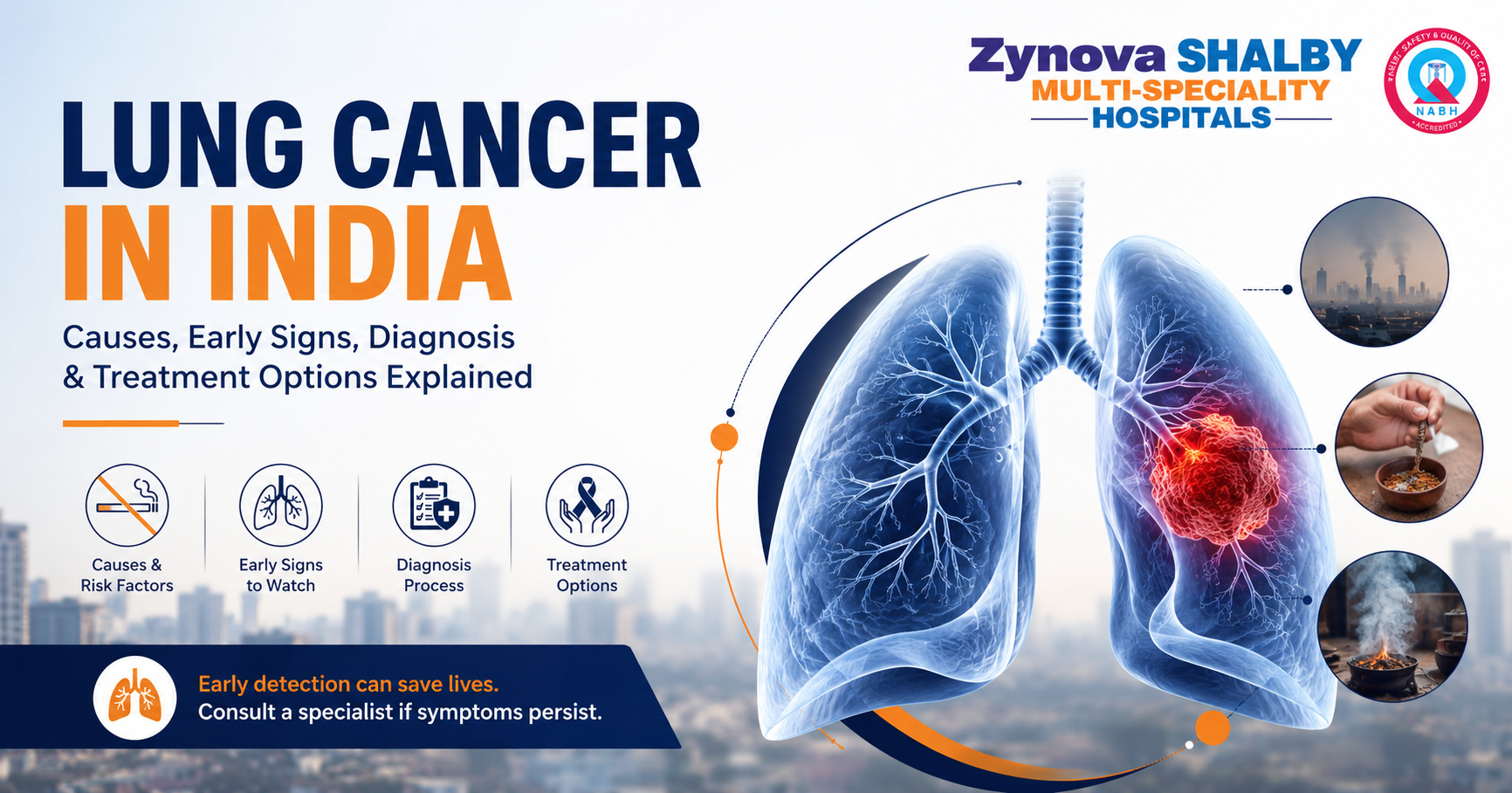
- Lung Cancer in India: Causes, Early Signs, Diagnosis and Treatment Options Explained
- admin
- 0 Comments
If you’ve searched for lung cancer information before landing here, chances are you found a lot of generic content written for a Western audience. Pages that talk about smoking as the main cause, list symptoms in clinical language, and never once mention air pollution, chulha smoke, or gutka. That’s a problem, because lung cancer causes and symptoms in India don’t always match what’s written on international health sites. The causes are different, the age at diagnosis is different, and a large number of patients here have never touched a cigarette in their life.
This guide covers the lung cancer risk factors relevant to Indian households, the lung cancer signs early stage patients tend to brush off as “just a cough,” how the lung cancer diagnosis process actually works here, and what lung cancer treatment in India looks like once you’re inside the system.
This is educational information, not a diagnosis. If any of this sounds like what you or someone in your family is going through, please see a pulmonologist or oncologist rather than relying on an article to guide next steps.
Why Lung Cancer Looks Different in India
A few numbers worth knowing, drawn from lung cancer India statistics published by the Indian Council of Medical Research and the National Cancer Registry Programme:
- Lung cancer cases in India were projected to cross 81,000 in men and over 30,000 in women by 2025, a sharp rise from the last decade.
- Indian patients are typically diagnosed in their mid-50s, about ten years earlier than patients in Western countries.
- Roughly 75-80% of cases are caught only at stage 3 or 4, when the cancer has already spread beyond the lung. That’s the single biggest reason survival rates here remain lower than they should be.
- Lung cancer is no longer just a men’s disease in India. Rates among women are rising steadily in several major cities.
None of this is meant to alarm you. It’s meant to explain why “wait and see” is the wrong approach with lung symptoms that don’t go away, and why catching this early makes such a dramatic difference to outcomes.
Causes and Risk Factors: What’s Actually Driving This in India
Smoking, But Not Only Cigarettes
Tobacco remains the leading cause among all lung cancer risk factors, and India has close to 100 million adult smokers. But smoking here isn’t limited to cigarettes. Bidis, hookah, and smokeless tobacco (gutka, khaini, paan masala) all carry cancer risk, and smokeless tobacco in particular tends to get dismissed as “safer” than smoking. It isn’t, and it’s linked to oral and lung cancers both.
Air Pollution
This is where Indian risk factors diverge sharply from what global health sites talk about. Long-term exposure to PM2.5 pollution, the kind that spikes in Delhi-NCR, Mumbai, and most major Indian cities every winter, is a well-established driver behind air pollution lung cancer in India, including in people who have never smoked. If you live in a high-pollution city and have a persistent cough, that context matters.
Biomass Fuel Exposure
In many Indian households, especially in rural areas, cooking is still done using chulhas fired by wood, dung cakes, or crop residue. Years of exposure to this indoor smoke is a well-documented lung cancer risk, and it disproportionately affects women, since they’re usually the ones cooking. This single factor barely gets a mention on most lung cancer websites, despite being a real and significant cause here.
Occupational Exposure
Workers in construction, mining, and certain factory settings face exposure to asbestos, silica dust, and diesel exhaust, all linked to lung cancer risk. If your job involves years of exposure to dust or industrial fumes, it’s worth mentioning to your doctor even if you’ve never smoked.
Genetic and Molecular Factors
Roughly one in five lung cancer cases worldwide occurs in people who have never smoked, and the pattern of lung cancer in nonsmokers India appears to skew meaningfully higher among women here. A notable share of these cases are driven by specific gene mutations (EGFR being the most common in Indian patients), not tobacco at all. This matters clinically too, because these mutations respond to targeted drug therapies that wouldn’t necessarily be the first choice for a smoking-related cancer.
Secondhand Smoke and Family History
Living with a smoker for years raises risk even if you’ve never smoked yourself. A family history of lung cancer also modestly raises individual risk, though it’s a smaller factor than tobacco or pollution exposure.
Early Signs That Are Easy to Ignore
This is the part that costs the most lives, not because people don’t have symptoms, but because the early ones look so ordinary that nobody takes them seriously until much later.
Symptoms worth paying attention to if they persist beyond 2-3 weeks:
- A cough that won’t go away, or one that changes character (gets worse, becomes dry when it used to bring up phlegm, or vice versa)
- Coughing up blood or blood-tinged mucus, even a small amount
- Breathlessness that seems out of proportion to your activity level
- Chest pain that gets worse with deep breathing, coughing, or laughing
- A hoarse voice that doesn’t clear up
- Unexplained weight loss or loss of appetite
- Recurring chest infections or pneumonia in the same area of the lung
- Persistent fatigue that isn’t explained by anything else going on in your life
Individually, every one of these can be something far less serious. A lingering cough after a viral infection, or fatigue from a stressful few weeks at work, is common and usually not cancer. The pattern to watch for is persistence without an obvious cause. A cough that should have resolved in ten days and is still there after four weeks deserves a doctor’s visit, not another round of home remedies.
When to See a Specialist
As a general rule, see a pulmonologist if:
- A respiratory symptom (cough, breathlessness, chest pain) has lasted more than 3 weeks without improvement
- You’ve coughed up any blood, even once
- You’re a current or former smoker over 40 with any new respiratory symptom
- You’ve had repeated chest infections in the same location
- You have unexplained weight loss along with any lung symptom
You don’t need to wait for a referral to see a pulmonologist in India. If your regular doctor has already tried antibiotics or cough syrup without improvement, that’s usually the moment to ask for a chest X-ray and a specialist opinion directly, rather than trying a second round of the same treatment.
How Lung Cancer Is Diagnosed in India
The lung cancer diagnosis process usually follows this order, though your doctor may adjust it based on your symptoms:
- Chest X-ray — Often the first step, and it can pick up visible masses, but it isn’t sensitive enough to rule out cancer on its own.
- CT scan of the chest — Gives a far more detailed picture of any nodule or mass, its size, and location. This is usually the next step if the X-ray shows something abnormal or if symptoms are strong enough to warrant it despite a normal X-ray.
- Biopsy — The only way to confirm cancer and identify its exact type. This might be done via bronchoscopy (a scope passed into the airways), a needle biopsy guided by CT, or occasionally surgery, depending on where the tumour is located.
- Molecular and biomarker testing — For non-small cell lung cancer, tissue from the biopsy is often tested for mutations like EGFR, ALK, and ROS1. This step is particularly important for nonsmokers and younger patients, since it directly decides whether targeted therapy is an option.
- PET-CT scan — Used to check whether the cancer has spread beyond the lung, which determines the stage and, in turn, the treatment plan.
- Additional staging tests — Depending on findings, this may include an MRI of the brain or a bone scan to rule out spread to other organs.
The full workup, from first scan to a confirmed treatment plan, typically takes anywhere from a week to a few weeks in a well-equipped centre, faster if the case is being handled at a dedicated cancer hospital with in-house pathology and imaging.
Treatment Options Available in India
Lung cancer treatment in India depends heavily on the type of lung cancer, its stage, and molecular test results. Most patients will encounter some combination of the following:
Surgery — An option mainly for early-stage cancer that hasn’t spread. This can range from removing a small part of the lung to removing an entire lobe, depending on tumour size and location.
Chemotherapy — Uses drugs to kill fast-dividing cancer cells, given in cycles, often alongside other treatments. It remains a core treatment for many stages of lung cancer.
Radiation therapy — Uses high-energy beams to target and shrink tumours. Used on its own for patients who aren’t surgical candidates, or combined with chemotherapy.
Targeted therapy — For patients whose biopsy shows a specific mutation (EGFR, ALK, and others), targeted drugs can control the cancer with generally fewer side effects than standard chemotherapy. Targeted therapies are available for cancers with specific actionable molecular alterations and may provide an effective treatment option for eligible patients. This is a significant option for Indian nonsmokers, particularly women, given how often these mutations show up in that group.
Immunotherapy — Works by helping the body’s own immune system recognise and attack cancer cells. Increasingly used for certain types and stages of lung cancer, sometimes combined with chemotherapy.
Most major cancer centres in India now offer all of the above, including robotic and minimally invasive surgical options. The right combination is decided by a tumour board, a multidisciplinary team of oncologists, surgeons, and radiologists reviewing the case together, rather than a single doctor.
A Note on Treatment Cost
Lung cancer treatment cost in hospital settings varies widely based on stage, treatment type, and facility, and it’s genuinely hard to quote an accurate number without knowing the specifics of a case. As a rough sense of range, early-stage surgery alone tends to cost less than a full course of chemotherapy plus radiation for advanced-stage disease, and targeted therapy or immunotherapy drugs are typically the most expensive component of treatment, sometimes running for months. Ask your hospital for an itemised cost estimate once staging is complete. If you’re looking for a chemotherapy center near me, most NABH-accredited hospitals in Mumbai will provide this upfront and help you navigate insurance and cashless claims.
Choosing a Hospital for Lung Cancer Treatment
A few things worth checking before you commit to a treatment centre:
- NABH accreditation — This is India’s national benchmark for hospital quality and safety standards. An NABH accredited cancer hospital Mumbai has been independently assessed on clinical protocols, infection control, and patient safety.
- A dedicated thoracic or pulmonary oncology team — Lung cancer targeted drugs can control the cancer with generally fewer side effects than standard chemotherapy. treated by a general oncology department is not the same as lung cancer treated by specialists who handle it routinely.
- In-house diagnostics — Hospitals with their own CT, PET-CT, and pathology labs cut down significantly on the time between “something looks off” and “here’s your treatment plan.”
- Access to a full range of treatments under one roof — Surgery, chemotherapy, radiation, and targeted therapy all available at the same centre means less running between hospitals during an already difficult time.
If you’re searching for a lung cancer hospital in Mumbai, or specifically a lung cancer specialist hospital in Ghatkopar, it’s worth looking for a centre with an established thoracic surgery and medical oncology unit rather than travelling across the city for every appointment. A genuine lung cancer surgery hospital in Mumbai should be able to take you from diagnosis through surgery, chemotherapy, and follow-up without handing you off between unconnected facilities. Continuity of care with one team tends to make the whole process considerably less exhausting for patients and families alike, which is exactly the kind of care we aim to offer at Zynova Shalby Hospital, one of the best hospital for lung cancer treatment options in Ghatkopar, Mumbai. Zynova Shalby Hospital in Ghatkopar provides multidisciplinary care involving thoracic surgery, medical oncology, pulmonology and diagnostic services.
Meet the Specialist
This article has been medically reviewed by Dr. Prriya Eshpuniyani, Consultant, Thoracic Surgery & Surgical Oncology at Zynova Shalby Hospital, Ghatkopar, Mumbai. Dr. Eshpuniyani specialises in the surgical management of lung and chest cancers, and works alongside the hospital’s pulmonology, medical oncology, and radiology teams to manage lung cancer cases from diagnosis through to treatment and follow-up. You can view her full profile or book a consultation on the Zynova Shalby Hospital doctors page.
The Bottom Line
Lung cancer in India has its own pattern: earlier age at diagnosis, a meaningful share of nonsmoker cases, and risk factors like air pollution and biomass fuel exposure that most global health content simply doesn’t cover. The good news is that awareness of these India-specific risks, combined with not ignoring a cough or breathlessness that overstays its welcome, is exactly what closes the gap between late-stage and early-stage diagnosis.
If you’ve been putting off that chest X-ray or that visit to a pulmonologist, let this be the nudge. Early-stage lung cancer has genuinely good treatment outcomes. The earlier it’s caught, the more options you have.
This article is for informational purposes only and isn’t a substitute for professional medical advice. Please consult a qualified pulmonologist or oncologist for any concerns about your health.
Leave a Comment