Best Hospital in Ghatkopar, Mumbai | Zynova Shalby Hospital


Piles vs Fissure vs Fistula: Symptoms, Causes & Treatment Guide
- Home
- Anal Pain or Bleeding? It could be piles, a fissure, a fistula, or hemorrhoids.
- admin
- 0 Comments
Most people who notice blood in the toilet bowl, pain while passing stools, or itching near the anus assume it’s piles and either ignore it or reach for an over the counter cream. Sometimes that guess is right. Often it isn’t. Piles symptoms, anal fissure symptoms, and anal fistula symptoms overlap enough to fool almost anyone, and mixing them up is one of the most common reasons people stay in pain for months longer than they need to.
If you’ve been trying to work out piles vs fissure vs fistula on your own, or searching things like anal pain causes, rectal bleeding causes, or blood in stool causes at 1 a.m. because you didn’t want to say any of this out loud to a doctor, this is written for you. We’ll walk through what actually separates these three conditions, what counts as a genuine emergency, where piles treatment without surgery and painless piles treatment actually apply, and where laser surgery becomes the realistic option. Towards the end, we’ll talk about what to look for before choosing a piles specialist in Mumbai, since a lot of clinics advertise the same laser packages without the same depth of experience in harder cases.
There’s also an embarrassment factor nobody talks about enough. This part of the body isn’t something people bring up over dinner, sometimes not even with their own family doctor. That silence is exactly why fissures and fistulas get quietly misdiagnosed as piles for years. I’ve seen the pattern often enough while researching this that it’s worth saying plainly: if you’ve been putting this off, you’re not unusual, and it’s genuinely not worth waiting any longer. The reassuring part is that general surgery in Mumbai has grown enough in this space that proper anorectal care is now easy to find close to home, without having to explain yourself twice or sit through an uncomfortable waiting room conversation.
Piles, Fissure, and Fistula Are Not the Same Thing
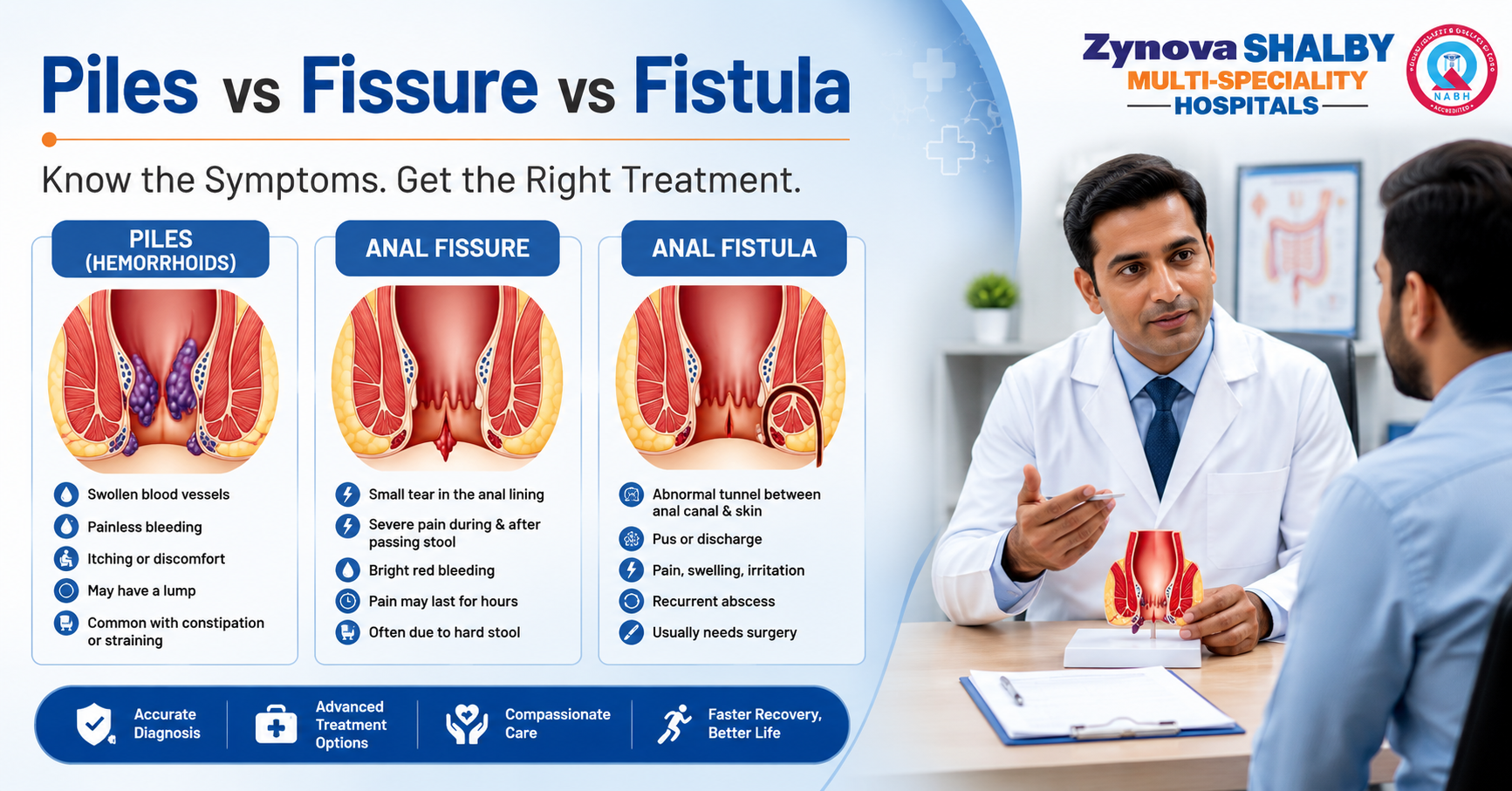
Piles, also called hemorrhoids, are swollen blood vessels inside or around the anal canal. Everyone has these vascular cushions naturally. They only become “piles” when they enlarge, bleed, or push out during bowel movements. Straining, chronic constipation, prolonged sitting, and pregnancy are the usual hemorrhoids causes. Piles are graded 1 to 4 depending on how far they protrude, and that grading is really what decides whether you need a diet change, a banding procedure, or surgery.
An anal fissure is a small tear in the lining of the anal canal, most often caused by passing a hard stool. It’s sharp, sometimes described as passing broken glass, and the pain can drag on for hours after you’ve actually finished using the toilet. Fissures under six weeks old are called acute. Ones that stick around longer become chronic, sometimes with a small skin tag forming near the tear (confusingly called a sentinel pile, which has nothing to do with actual piles).
An anal fistula is a small tunnel that forms between the inside of the anal canal and the skin outside it, usually after an abscess, a pocket of infection, has drained on its own or been cut open. Unlike piles or fissures, a fistula almost never heals with medication or diet alone. There’s an actual physical tunnel that needs closing, whether through fistulotomy, a laser procedure, or techniques like LIFT or VAAFT depending on how complicated the tract is.
Getting the right diagnosis changes everything about how it’s treated. A symptom checklist can point you in a direction, but it can’t replace an actual exam by someone who does this every day.
Symptoms: What Points to What
| Symptom | Piles | Fissure | Fistula |
| Painless bleeding, bright red, on the stool surface | Common | Uncommon | Rare |
| Sharp pain during and after passing stool | Rare, unless thrombosed | Classic sign | Sometimes |
| Constant dull ache, worse when sitting | Sometimes | Sometimes | Common |
| Pus or foul smelling discharge | No | No | Classic sign |
| A lump or swelling you can feel externally | Common (grade 3 to 4) | Occasionally, a skin tag | Common, an opening near the anus |
| Anal itching causes on their own, no bleeding | Common | Occasionally | Occasionally |
| Recurrent boils or abscesses in the same spot | No | No | Common |
If it’s just itching, with no bleeding or real pain, that’s usually piles, skin irritation, or a mild fungal issue rather than anything surgical. But persistent discharge, a lump that keeps returning, or an ache that’s there even when you’re not passing stool leans towards a fistula, and that needs an in person exam, not another week of home remedies.
What Causes These Conditions in the First Place
A quick word on prevention, since this comes up as often as treatment does. Piles and fissures share most of the same root causes: low fiber diets, not drinking enough water, sitting for long stretches at a desk, straining during bowel movements, and pregnancy related pressure on the pelvic floor. Fistulas usually start differently, from an anal gland infection that turns into an abscess, though poor hygiene, Crohn’s disease, and diabetes can all raise the risk of one forming or recurring.
None of this means every case is preventable. Genetics play a role too, and plenty of people with a fibre rich diet and an active lifestyle still develop piles or a fissure. But if constipation is a recurring theme in your life, addressing that alone resolves a surprising number of mild cases before they ever need a procedure.
When It’s Not Just Piles: Warning Signs You Shouldn’t Sit On
A lot of anal pain causes are benign and settle with fiber, water, and a stool softener. But get seen urgently if you notice:
- Rectal bleeding that’s heavy, dark, or mixed into the stool rather than sitting on top of it
- Fever along with anal pain or swelling, which can point to an abscess that needs draining before it spreads
- A new lump that’s growing, especially with drainage or a bad smell
- Unexplained weight loss along with a change in bowel habits
- Bleeding in anyone over 45, or with a family history of colorectal cancer, even if it looks exactly like typical piles bleeding
This isn’t meant to alarm you into treating every symptom as serious. Most anorectal complaints really are what they look like. But blood in stool causes range from a minor fissure to something that needs a colonoscopy to rule out, and the only way to know which one you’re dealing with is an actual examination.
Do You Really Need Surgery? Non-Surgical Options First
This is where a lot of clinics jump straight to selling a laser package, so it’s worth knowing what genuinely doesn’t need an operating table:
- Grade 1 and 2 piles often respond to increased fiber intake, sitz baths, topical medication, and rubber band ligation, a simple outpatient procedure with no cutting involved.
- Acute fissures frequently heal on their own within three to six weeks with stool softeners, a high fiber diet, and topical creams that relax the anal sphincter.
- Botox injections are a genuine non-surgical option for chronic fissures that haven’t responded to creams, relaxing the muscle spasm that keeps re-tearing the fissure in roughly six to seven out of ten cases.
- Small, uncomplicated fistulas are the exception here. There isn’t a reliable non-surgical route. A tunnel between two surfaces needs to be closed, and delaying that usually means more tunnels forming, not fewer.
If you’ve been searching piles treatment without surgery, this genuinely exists for early grade piles and acute fissures. It’s higher grade piles, chronic fissures that haven’t responded to medication, and essentially all fistulas where laser fistula surgery or conventional surgery becomes the realistic next step.
Laser Treatment: What It Actually Involves
Laser piles treatment in Mumbai has become the preferred option for piles, fissures, and fistulas over the past several years, and for reasonable reasons. Compared to traditional open surgery, laser procedures generally mean less post-operative pain since there’s minimal cutting of surrounding tissue, little to no stitches, same day discharge in most cases, and a return to normal activity within a few days rather than a few weeks.
For piles, laser hemorrhoidoplasty shrinks and seals off the swollen vessels. For fissures, laser sphincterotomy releases the muscle spasm without the open cut of a conventional sphincterotomy, which is what makes it a genuinely painless piles treatment option for most patients once the local anesthetic wears off. For fistulas, laser closure techniques such as FiLaC seal the tract from the inside, which tends to preserve sphincter function better than older methods.
On laser piles treatment cost, piles surgery cost in India, and fistula surgery cost, the honest answer is that it varies too much by clinic, city, surgeon experience, and how advanced the condition is for any single number to mean much on a blog. Anyone quoting you an exact figure before an actual examination is guessing. What you should ask for instead is a written breakdown after your consultation, covering the procedure, hospital stay, anesthesia, and any follow up visits, so there are no surprises on the final bill.
What Mumbai’s Proctology Market Looks Like Right Now
If you’ve searched best proctologist in Mumbai or piles specialist in Mumbai, you’ve probably run into a handful of names repeatedly: dedicated proctology chains with a strong presence in Andheri and Navi Mumbai, national daycare surgery networks with branches across the city, and smaller clinics run by individual specialists closer to the western suburbs. Most of them lean heavily on laser treatment marketing, EMI options, and patient testimonials, which makes sense given how price sensitive and privacy conscious this category of patient tends to be.
What’s less visible in most of that marketing is depth on the harder cases, recurrent fistulas, complex tracts, and patients who’ve already had one failed surgery elsewhere. That’s a genuinely different skill set from managing a straightforward grade 2 pile, and it’s worth asking directly how many complex fistula cases a surgeon has personally handled before you commit, rather than going purely on star ratings or how polished the website looks.
Why People in Ghatkopar Choose Zynova Shalby’s General Surgery Team
If you’re in Ghatkopar, Vikhroli, or the surrounding parts of Mumbai and you’d rather not travel across the city for a sensitive consultation, the General Surgery department at Zynova Shalby Hospital handles the full range of anorectal conditions locally, from grade 1 piles managed with medication, through banding procedures, up to laser and conventional surgery for complex fistulas. As a general surgeon in Ghatkopar patient base, this is one of the few local options where you don’t need to travel to Andheri or Navi Mumbai for a proper proctology consult.
A few things patients tend to mention when they come in:
- Consultations are private and unhurried. You won’t be rushed through an exam, and the team is used to patients who feel awkward describing their symptoms.
- Diagnosis comes before any treatment recommendation. Not every case needs surgery, and the surgeons here will tell you plainly when medication or a minor procedure is enough.
- Laser options are available for piles, fissures, and fistulas, performed by the hospital’s own general surgery team rather than outsourced to a visiting specialist.
- It’s a full hospital setup, not a standalone daycare clinic, so if a case turns out to be more complex than expected, there’s no need to be referred elsewhere mid-treatment.
If embarrassment has been the thing keeping you from a visit, it helps to remember that the surgeons doing this every week have seen far more unusual and far more advanced cases than whatever is bothering you. Waiting rarely makes an anorectal problem simpler to treat, and in the case of fistulas especially, it often makes the eventual surgery more complicated.
Frequently Asked Questions
Can piles go away without any treatment at all?
Mild, grade 1 piles sometimes settle on their own once constipation is managed, but grade 3 and 4 piles rarely resolve without a procedure.
Is laser surgery painful?
Most patients describe mild discomfort for a couple of days rather than significant pain, which is why it’s often marketed as painless, though “minimal pain” is the more accurate description.
How is a fistula different from an abscess?
An abscess is the active infection, a fistula is what’s often left behind once that infection has drained, a tunnel connecting the inside of the anal canal to the skin outside.
Do I need a colonoscopy if I have rectal bleeding?
Not always, but your surgeon may recommend one if the bleeding pattern is unusual, you’re over 45, or there’s a family history of colorectal cancer, just to rule out other causes.
Can fissures or fistulas come back after treatment?
Fissures can recur if constipation isn’t managed afterward. Fistulas have a higher recurrence rate, particularly complex ones, which is part of why experienced surgical judgment matters more here than in simpler cases.
When to Book a Consultation
Book a visit rather than waiting it out if you have:
- Bleeding that’s new, heavy, or doesn’t settle within a few days of dietary changes
- Pain that’s sharp enough to make you dread using the toilet
- Any discharge, swelling, or a lump that keeps returning near the anus
- Symptoms that haven’t improved after two to three weeks of home care
The General Surgery team at Zynova Shalby Hospital, Ghatkopar, offers confidential consultations to get you a clear diagnosis and a treatment plan built around your specific grade and condition, not a generic package.
Leave a Comment