Best Hospital in Ghatkopar, Mumbai | Zynova Shalby Hospital


Dengue vs Malaria vs Leptospirosis: Know the Difference
- Home
- Dengue vs Malaria vs Leptospirosis: How to Tell Them Apart
- admin
- 0 Comments
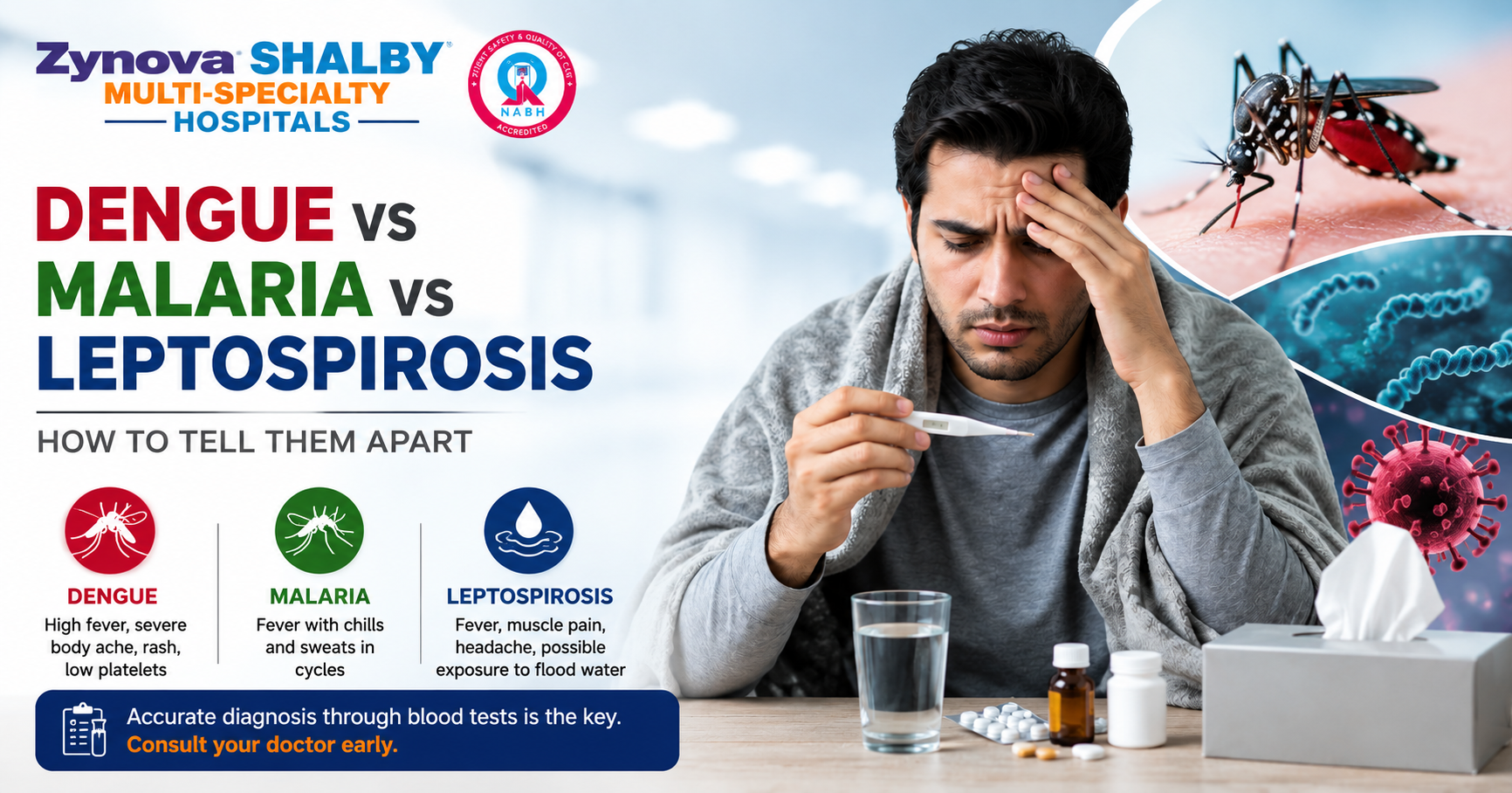
Fever shows up during monsoon and the first question is never “what’s wrong with me.” It’s “which one is this.” Dengue, malaria, leptospirosis, they all start the exact same way. Sudden fever. Body ache. That flattened-out, can’t-get-off-the-bed tiredness. Nobody walks into a clinic with the answer already sorted out in their head, and honestly, they shouldn’t have to. That’s the doctor’s job.
What actually tells these three apart doesn’t show up on day one. It shows up a bit later, in how the fever behaves over the next few days, and in exactly where the pain decides to live. Here’s a rundown of dengue vs malaria symptoms, the difference between dengue and leptospirosis, malaria vs typhoid symptoms, and how to tell dengue from malaria before you’re sitting across from a doctor trying to remember what you were even doing a week ago. And what a fever after monsoon rain should actually push you to do, instead of just waiting it out with paracetamol and hope.
Why people keep mixing these up
Dengue and malaria both come from mosquito bites. Different mosquitoes though, and they bite at different times of day, which matters more than people think. Leptospirosis isn’t a mosquito thing at all. It’s bacteria, sitting in flood water or wet soil, usually from rat urine, and it gets into you through a cut or a scrape you probably didn’t even clock at the time. Maybe a scratch from a fence. Maybe just skin that stayed wet too long while you were wading home.
And here’s the thing nobody expects: you can get more than one of these together. Dengue from a mosquito bite one week, leptospirosis from the same flooded street the next. It happens more than people assume. Which is really the whole point of this article, symptoms alone won’t tell you enough. A blood test will.
Dengue symptoms in adults
Dengue tends to show up four to seven days after the bite, sometimes it takes closer to two weeks. The fever isn’t gentle about it either, it climbs fast, often past 103°F, and it never really comes alone. Ask anyone who’s had it and they’ll tell you the body ache was unlike anything else they’ve felt, deep in the joints, which is exactly why people still call it “breakbone fever” even now.
So what does dengue symptoms in adults actually look like in practice? A few things tend to show up together:
- A sudden high fever that sticks around for two to seven days
- Pain right behind the eyes, plus a headache that regular painkillers barely touch
- Joint and muscle pain that feels deeper than a normal ache
- A rash, usually a few days in, not always on day one
- Nausea, or just not wanting to eat anything at all
- Small red spots, or bruises that show up without you bumping into anything
Here’s the part that trips people up. Dengue often gets worse right as the fever starts coming down, not while it’s at its peak. Somewhere around day three to five, platelets can drop fast, and that’s exactly when the real warning signs turn up: belly pain, throwing up repeatedly, bleeding gums, restlessness, or a tiredness that just doesn’t match how “mild” the fever looks now. If any of that hits after the fever’s already broken, that’s not a wait-and-see moment anymore.
As for the dengue platelet count normal range, a healthy adult usually sits somewhere between 150,000 and 450,000 platelets per microliter. Dengue can push that number under 100,000, sometimes a lot further down, which is why one blood test on day one isn’t enough. Doctors keep checking.
Malaria fever pattern, the one clue dengue doesn’t give you
Malaria takes its time. Usually 10 to 15 days after the bite before anything shows up. But once it does, there’s a pattern to it that dengue simply doesn’t have, the malaria fever pattern. Instead of staying high for days on end, malaria cycles. Shivering and chills first, then the fever spikes, then a drenching sweat as it breaks, and then, oddly, you feel almost normal for a while before the whole thing starts over a day or so later.
That cycle, chills, spike, sweat, calm, repeat, is honestly the most useful thing you can describe to a doctor over the phone if you’re trying to figure out how to tell dengue from malaria before you’ve even left the house. Malaria brings headache and body ache too, sure, but the joint pain rarely gets anywhere near as brutal as dengue’s. And that in-between calm stretch? Dengue basically never gives you that.
Since malaria vs typhoid symptoms turns up in a lot of the same searches, it’s worth a quick word on that too. Typhoid tends to creep up slowly over several days instead of spiking overnight, often climbing in steps, and it leans more toward stomach pain along with either constipation or diarrhea, not the chills-then-sweat cycle malaria runs on. Typhoid also comes from bad food or water, not a mosquito, so if you’ve eaten something questionable recently, say so.
Getting malaria confirmed just needs a blood smear under a microscope, or a rapid test. On malaria blood test cost, it’s actually one of the cheaper fever tests out there, and results usually land within a few hours, not days.
Leptospirosis symptoms and treatment
Leptospirosis comes from Leptospira bacteria, living in the urine of rats and other animals, getting in through a cut, a scrape, or skin left wet for too long. It shows up anywhere from 5 to 14 days after exposure. The one symptom that separates it most clearly from dengue and malaria? Calf pain. Deep, tender, and often worse than the rest of the illness would suggest it should be.
That calf pain fever leptospirosis combination, paired with red eyes that aren’t watery or itchy, is one of the strongest signals a doctor has before any report comes back. A lot of decisions around leptospirosis symptoms treatment get made purely on that pattern, because waiting around for lab confirmation can eat up time a patient just doesn’t have.
A few other things worth flagging:
- High fever with chills
- A headache that feels sharper than a usual viral one
- Muscle pain focused in the calves and lower back
- Red eyes, no discharge
- Nausea and vomiting
- In worse cases, yellowing of the skin or eyes, less urination, or trouble breathing
Treatment is usually antibiotics, doxycycline or penicillin, and starting early makes a real difference. This is actually where leptospirosis and dengue split hardest. Dengue has no antiviral cure, you manage it with fluids and watching closely. Leptospirosis, on the other hand, actually responds to antibiotics if you catch it in time. In severe cases it can hit the kidneys and liver too, so those get checked alongside everything else.
Quick comparison
Dengue | Malaria | Leptospirosis | |
Cause | Virus, daytime-biting Aedes mosquito | Parasite, nighttime-biting Anopheles mosquito | Bacteria, contaminated flood water |
Onset after exposure | 4 to 7 days | 10 to 15 days | 5 to 14 days |
Fever pattern | High, stays up for days | Cyclical, chills then spike then sweat | High and steady, sometimes two phases |
Standout symptom | Severe joint pain, pain behind the eyes | Chills followed by heavy sweating | Calf muscle pain, red eyes |
Confirming test | NS1 antigen or dengue IgM/IgG | Blood smear or rapid antigen test | Leptospira antibody test (MAT/IgM) |
Danger sign | Falling platelets, bleeding, belly pain | Fever cycles keep recurring, anemia | Jaundice, less urination |
Is my fever dengue or just a normal viral fever
If you’re reading this with a thermometer in your hand, this is probably the real question. Is my fever dengue or normal viral fever, and honestly, a plain viral fever usually calms down within two to three days on rest, fluids, and paracetamol. It doesn’t usually bring the severe joint pain, the rash, the bruising. Dengue, malaria, leptospirosis, they tend to stick around longer, and they get sharper as the days go on instead of easing off.
A rough rule that’s held up pretty well: fever crosses 100.4°F and hangs on past 48 hours, or shows up with real body pain, calf pain, red eyes, a rash, repeated vomiting, get a blood test. Don’t wait it out. Most delayed-treatment cases aren’t people ignoring obvious red flags. It’s usually someone reasonably assuming “it’s just the monsoon thing going around” for three or four days before finally coming in.
When to actually get a blood test
Knowing when to get a blood test for dengue, or malaria, or leptospirosis, matters just as much as knowing the symptoms in the first place. Worth testing if:
- Fever’s above 100.4°F for more than two days
- Fever comes with real body, joint, or eye pain
- Calf pain shows up with the fever, especially after wading through flood water
- There’s a rash or bruising you can’t explain
- The fever comes in waves, chills then sweating then it’s back
- It’s a child, an elderly person, or someone already managing something like diabetes or kidney disease
A standard fever panel usually runs a complete blood count, dengue NS1/IgM, a malaria smear or antigen test, and, if calf pain or flood exposure fits the picture, a leptospirosis test on top. Doing all of it in one sitting, instead of chasing results one at a time across separate visits, saves days that genuinely matter.
Getting the right diagnosis
Most bad outcomes with monsoon fevers don’t come from the illness itself being untreatable. They come from the diagnosis taking too long to land. Zynova Shalby Hospital in Ghatkopar runs same-day fever panels covering dengue, malaria, and leptospirosis together, with an in-house lab, so reports aren’t sitting somewhere else for a day while a platelet count keeps quietly dropping.
Whether you’re looking for a dengue test near me Ghatkopar, a fever specialist in Mumbai, or a monsoon emergency hospital that can actually admit and watch you if platelets fall or kidney numbers start moving, that’s the kind of care an emergency hospital in Mumbai needs to offer once monsoon really gets going. At Zynova Shalby Hospital, the doctors look at your exposure history, how the fever’s behaving, and exactly where it hurts, before the reports even come back.
The bottom line
Dengue, malaria, leptospirosis, they all open with the same three words. Fever, ache, fatigue. What actually separates them is timing, the shape of the fever, and where the pain settles. None of that replaces an actual blood test, but knowing the difference changes how urgently you move.
If someone at home has had a fever for more than two days this monsoon, don’t sit on it. Get the fever panel done at Zynova Shalby Hospital, Ghatkopar, and find out what you’re actually dealing with.
Leave a Comment