Best Hospital in Ghatkopar, Mumbai | Zynova Shalby Hospital


Breast Cancer Stages 0 to 4: Symptoms & Treatment
- Home
- Breast Cancer Stages Explained: Stage 1 to Stage 4
- admin
- 0 Comments
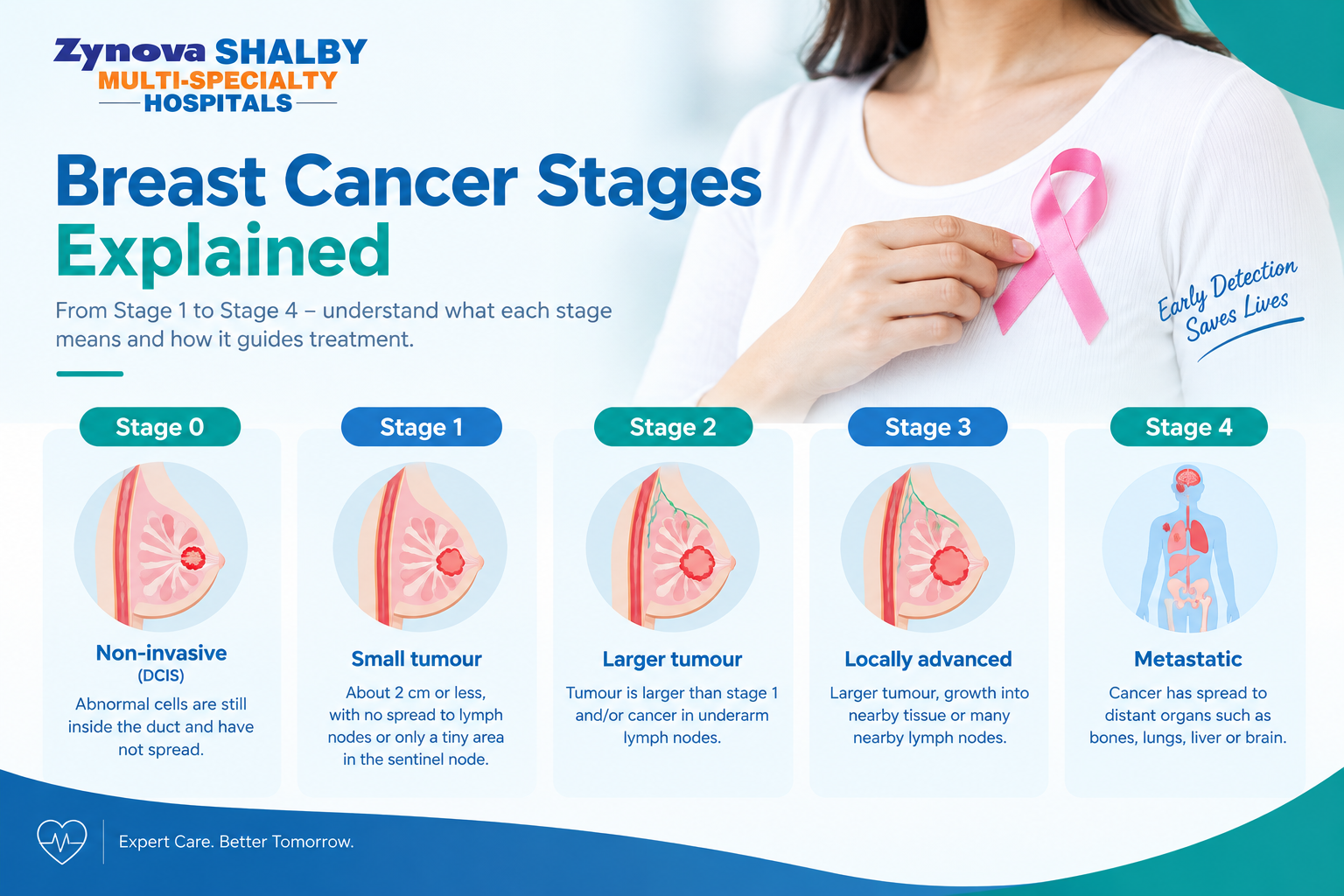
Breast cancer stages describe how big a breast tumour is and how far the cancer has spread. Doctors number them from 0 to 4. A lower number generally means the cancer is smaller and more contained. Stage 4 means it has spread to distant parts of the body, such as the bones, lungs, liver or brain.
If you or someone in your family has just received a diagnosis, the word ‘stage’ can feel heavy. It helps to know what it actually measures. The stage is a way for the care team to describe the cancer clearly and plan treatment that fits. It does not decide everything, and it is only one of several things your doctors look at.
This guide explains breast cancer staging in plain language. It walks through stage 1 breast cancer, stage 2, stage 3 and stage 4, shows how doctors work out the stage, and describes how breast cancer treatment by stage is usually approached. Your own reports and your oncologist’s advice always come first.
What does breast cancer staging mean?
Staging is the process of finding out whether a cancer has spread and, if so, how far. The American Cancer Society (ACS) describes the stage as a measure of how much cancer is in the body, which helps show how serious it is and how best to treat it.
You may see stages written in Roman numerals on your reports: 0, I, II, III and IV. They match the numbers 0 to 4 used here. As a rule, the lower the number, the less the cancer has spread. Letters add detail, and within a stage an earlier letter means a lower stage, so 2A sits below 2B.
The stage is worked out from a physical exam, imaging tests and biopsies. Depending on the system used, breast cancer staging can bring together tumour size, lymph-node involvement, spread to distant organs, tumour grade and biomarker results (hormone receptor and HER2 status).
How do doctors determine the stage of breast cancer?
Most doctors use the TNM system from the American Joint Committee on Cancer (AJCC). Three letters carry most of the weight.
T: tumour size
T describes the main tumour and whether it has grown into the skin or the chest wall under the breast. Higher numbers mean a larger tumour or wider growth into nearby tissue.
- T1: 2 cm or less (about three quarters of an inch)
- T2: more than 2 cm and up to 5 cm
- T3: more than 5 cm
- T4: any size, growing into the chest wall or skin
N: lymph nodes
Lymph nodes are small, bean-shaped glands that filter fluid in the body. N tells you whether cancer has reached nearby nodes and how many are involved.
- N0: no cancer found in nearby lymph nodes
- N1: cancer in 1 to 3 lymph nodes under the arm, or very small spread to nodes near the breastbone found on sentinel node biopsy
- N2: cancer in 4 to 9 underarm nodes, or enlarged nodes near the breastbone
- N3: cancer in 10 or more underarm nodes, or in nodes below or above the collarbone
M: distant spread
M stands for metastasis, which means spread to distant organs.
- M0: no distant spread found
- M1: spread to distant organs such as the lungs, liver, bones or brain
Clinical stage, pathologic stage and prognostic stage
Your first stage is usually the clinical stage. It is based on the physical exam, imaging and biopsy. After surgery, the tissue that was removed is examined under a microscope, which gives the pathologic stage, also called the surgical stage. ACS notes that the cancer has sometimes spread further than the clinical stage suggested. So your stage can be refined after surgery or further tests. That is a normal part of the process.
You may also hear the terms anatomic stage and prognostic stage. The anatomic stage uses only tumour size, lymph nodes and distant spread. The prognostic stage, part of the AJCC system used since 2018, combines those with grade, hormone receptor and HER2 results, and sometimes a gene test score. It also comes in clinical and pathologic versions. This is why your report can show a different stage from the one you would reach from size and nodes alone.
Other findings that shape your stage and treatment plan
Your pathology report will usually include these details:
- Grade describes how abnormal the cancer cells look and how quickly they are likely to grow. Low-grade cells look more like normal cells. High-grade cells look more abnormal and tend to grow faster. Grade and stage are different things, and people often mix them up.
- Hormone receptor status (ER and PR) shows whether the cancer cells carry receptors for the hormones estrogen and progesterone. When they do, hormone-blocking treatment can help.
- HER2 status shows whether the cells make too much of a protein called HER2. HER2-positive cancers can be treated with medicines that target that protein.
Some people also have a gene test, such as the Oncotype DX recurrence score. In certain early-stage, hormone receptor-positive, HER2-negative invasive cancers, the result can help you and your doctor decide whether chemotherapy is likely to add benefit, and it can be taken into account in staging. It is not needed for everyone.
Because these details are part of staging, two people with similar tumour sizes can end up with different overall stages. Ask your doctor about your own stage and what it means for you.
Breast cancer stages at a glance, with usual treatment approaches
The table gives a simplified description of each stage. It should not be used to determine an individual patient’s stage, which your doctors set from your reports.
Stage | Simplified description | What it often means for planning |
Stage 0 | Non-invasive cancer (such as DCIS). Abnormal cells have not broken out of the duct. | Usually surgery, sometimes with radiation |
Stage 1 | Small invasive tumour, about 2 cm or less, with no spread to lymph nodes or only a tiny area in the sentinel node | Surgery is the main treatment; other treatment depends on tumour features |
Stage 2 | Tumour larger than stage 1 and/or cancer in underarm lymph nodes | Surgery plus lymph node check; radiation and medicines are often considered |
Stage 3 | Locally advanced: larger tumour, growth into skin or chest wall, or many nearby lymph nodes | Often medicines first, then surgery and radiation |
Stage 4 | Metastatic: cancer has spread to distant organs | Medicine-based (systemic) treatment is the main treatment |
For more detail, see the American Cancer Society breast cancer stages guide and the National Cancer Institute breast cancer treatment guide.
Stage 0 breast cancer and DCIS
Stage 0 means carcinoma in situ. The abnormal cells are still inside the part of the breast where they began. The most common type is ductal carcinoma in situ (DCIS), where the cells are confined to the milk ducts.
DCIS cannot spread outside the breast, but if it is left untreated it may turn into an invasive cancer, which is why treatment is usually advised. Surgery is the main treatment. Radiation often follows a lumpectomy to lower the chance of DCIS coming back, and hormone therapy may be offered in some cases. Underarm lymph nodes are not usually removed for DCIS, because the cancer has not spread outside the duct.
Stage 1 breast cancer
Stage 1 breast cancer is an early invasive cancer. The tumour is small, about 2 cm or less, and it has either not reached the lymph nodes or has only a tiny area of spread in the sentinel node. The sentinel node is the first lymph node the cancer is likely to reach. Invasive means the cancer has grown beyond where it started into nearby breast tissue. Because grade and receptor results can also affect the stage, your report may show a stage that differs from what size and nodes alone would suggest.
Symptoms may be subtle or absent at this stage, which is one reason screening matters.
Surgery is the main treatment. It may be breast-conserving surgery (a lumpectomy, which removes the tumour and some surrounding tissue) or a mastectomy (removal of the breast). The nearby lymph nodes are also checked, often with a sentinel lymph node biopsy. Radiation commonly follows a lumpectomy. According to ACS, most people with stage 1, 2 or 3 breast cancer also receive some form of systemic therapy, meaning medicine that works throughout the body. Which type depends on the tumour’s grade and its hormone receptor and HER2 status.
Stage 1 treatment: typical steps
- Step 1 – Planning tests: Biopsy results (grade, hormone receptor and HER2 status) and sometimes a gene test such as Oncotype DX help shape the plan.
- Step 2 – Surgery: Lumpectomy (breast-conserving surgery) or mastectomy.
- Step 3 – Lymph node check: Sentinel lymph node biopsy to see whether cancer has reached the first node.
- Step 4 – Radiation: Commonly given after a lumpectomy; after a mastectomy it depends on the pathology report.
- Step 5 – Medicines, if needed: Hormone therapy for hormone receptor-positive cancers and HER2-targeted treatment for HER2-positive cancers. Chemotherapy is used only when tumour features or gene test results suggest it will help.
- Step 6 – Follow-up: Regular check-ups, mammograms and a plan for any long-term medicine.
Stage 2 breast cancer
Stage 2 breast cancer is still considered early-stage, but the tumour is larger than in stage 1, or cancer has reached lymph nodes under the arm on the same side, or both. It is divided into 2A and 2B, based on the combination of tumour size and lymph node involvement.
Treatment usually includes surgery, either a lumpectomy or a mastectomy, with the nearby nodes checked. Radiation after a lumpectomy is common. After a mastectomy, radiation may be discussed, and it is usually advised when cancer is found in the lymph nodes. Medicines such as chemotherapy, hormone therapy or targeted therapy are often part of the plan, and some people receive them before surgery. Giving medicine before surgery is called neoadjuvant treatment.
Stage 2 treatment: typical steps
- Step 1 – Planning tests: Biopsy, receptor and HER2 results, and imaging as your doctor advises.
- Step 2 – Medicine before surgery (in some people): Chemotherapy and/or HER2-targeted treatment may be given first to shrink the tumour. This is called neoadjuvant treatment.
- Step 3 – Surgery: Lumpectomy or mastectomy, with the underarm nodes checked by sentinel node biopsy or, when needed, node removal.
- Step 4 – Radiation: Common after a lumpectomy. After a mastectomy it is discussed and is usually advised when cancer is found in the lymph nodes.
- Step 5 – Medicine after surgery: Chemotherapy, hormone therapy or HER2-targeted treatment, depending on the pathology report.
- Step 6 – Follow-up: Regular check-ups and monitoring of long-term medicine.
Stage 3 breast cancer
Stage 3 breast cancer is called locally advanced. The cancer is larger, or is growing into nearby tissue such as the skin over the breast or the muscle underneath, or has spread to many nearby lymph nodes. It has not spread to distant organs. Stage 3 is divided into 3A, 3B and 3C according to how much tumour growth and lymph node involvement there is.
Inflammatory breast cancer is a rare form in which the breast looks red and swollen because cancer cells block lymph vessels in the skin. It is classed as at least stage 3B.
Treatment for stage 3 usually combines several approaches. ACS says these cancers are most often treated with chemotherapy before surgery, followed by surgery and radiation. Because a sentinel node biopsy is often not an option at this stage, removing the underarm nodes (axillary lymph node dissection) is often needed instead. Some people have surgery first. Hormone therapy or HER2-targeted treatment may be added, depending on the tumour’s receptors.
Stage 3 treatment: typical steps
- Step 1 – Full work-up: Biopsy, receptor and HER2 tests, and scans to check for spread to distant organs.
- Step 2 – Medicine first: Chemotherapy, with HER2-targeted treatment if the cancer is HER2-positive, is most often given before surgery to shrink the cancer.
- Step 3 – Surgery: Usually mastectomy, sometimes breast-conserving surgery if the cancer responds well, often with removal of the underarm lymph nodes (axillary lymph node dissection).
- Step 4 – Radiation: Commonly given to the chest wall or breast and nearby lymph nodes after surgery.
- Step 5 – Further medicines: Hormone therapy for hormone receptor-positive cancers, HER2-targeted treatment for HER2-positive cancers, and other medicines depending on how the cancer responded.
- Step 6 – Follow-up and reconstruction: Regular check-ups, and a discussion about breast reconstruction if you wish.
Stage 4 breast cancer
Stage 4 breast cancer, also called metastatic breast cancer, means the cancer has spread beyond the breast and nearby lymph nodes to distant parts of the body, most often the bones, lungs, liver or brain. Stage 4 is about where the cancer has spread, whatever the size of the tumour in the breast.
It can be found at the first diagnosis. It can also appear years after treatment for an earlier stage.
Stage 4 breast cancer is generally not considered curable with current treatments, but it is treatable. Treatment aims to control the cancer, ease symptoms and protect quality of life for as long as possible, and the options have grown in recent years. Medicines given throughout the body are the main treatment, and the choice depends on hormone receptor and HER2 status, and sometimes on gene changes in the cancer. People with hormone receptor-positive cancers are usually offered hormone therapy first. Hormone receptor-negative cancers are not all treated the same way. The plan also depends on HER2 status, other tumour characteristics and biomarker test results. For example, HER2-positive cancers are usually treated with HER2-targeted medicines, often together with chemotherapy, while triple-negative cancers may be treated with chemotherapy, and in some people with immunotherapy or other targeted medicines when biomarker tests show they are suitable. Surgery or radiation is sometimes added for specific problems. Treatment usually continues long term, and supportive and palliative care can sit alongside it to ease symptoms.
Stage 4 treatment: typical steps
- Step 1 – Confirm and re-test: Scans show where the cancer has spread. A biopsy of a spread site, where possible, re-checks hormone receptor and HER2 status and may include other biomarker tests.
- Step 2 – Choose medicine based on cancer type: The main treatment is medicine given throughout the body. The options depend on the type:
- Hormone receptor-positive, HER2-negative: hormone therapy is usually offered first, often with a targeted medicine. Chemotherapy is used when needed.
- HER2-positive (hormone receptor-positive or negative): HER2-targeted medicines, usually combined with chemotherapy or, if hormone receptor-positive, with hormone therapy.
- Triple-negative (hormone receptor-negative and HER2-negative): chemotherapy, and for some people immunotherapy or other targeted medicines, depending on biomarker results such as PD-L1 or BRCA status.
- Step 3 – Treat specific problems: Radiation or surgery may be added for particular problems, such as pain from bone spread, and bone-strengthening medicines may be used when the bones are involved.
- Step 4 – Supportive and palliative care: Given alongside cancer treatment to ease symptoms and protect quality of life.
- Step 5 – Regular review: Scans and check-ups show how the treatment is working, and the plan is changed if it stops working or side effects are too heavy.
Early-stage, locally advanced and metastatic: what is the difference?
These three terms often come up in conversations about early stage breast cancer and advanced breast cancer.
- Early-stage usually means stages 1 and 2 (and stage 0). The cancer is limited to the breast and, at most, a few nearby lymph nodes.
- Locally advanced means stage 3. The cancer is bigger or has spread more widely within the breast, skin, chest wall or lymph nodes, but not to distant organs.
- Metastatic means stage 4. The cancer has reached distant organs.
The phrase ‘advanced breast cancer’ is used loosely. Some people mean stage 3, and many mean stage 4. If you hear it, ask your doctor which one they mean. Terms also vary a little between doctors and hospitals.
Tests used for breast cancer diagnosis and staging
The tests depend on your situation. Your doctor will talk with you about which ones you need, so not everyone has all of them. Common ones include:
- Clinical breast exam and mammogram to look for changes in the breast.
- Ultrasound of the breast and underarm, which can also guide a needle to an enlarged lymph node for sampling.
- Breast MRI, which can show how far the cancer extends in the breast and whether nearby lymph nodes are involved.
- Biopsy, where a small sample is taken with a needle and examined by a pathologist. This confirms the diagnosis and gives the grade, hormone receptor status and HER2 status.
- Sentinel lymph node biopsy, usually done during surgery, to check whether cancer has reached the first lymph node.
- Scans for distant spread, such as a chest X-ray, CT scan, MRI, PET/CT or bone scan. These look for spread to the bones, lungs, liver or brain. They are not routine for everyone, and your doctor decides based on your stage, symptoms and findings.
At Zynova Shalby Hospital, the oncology department lists mammography, biopsy and laboratory testing, and the hospital’s diagnostic services include ultrasonography, CT and MRI. Your oncologist will advise which of these apply to you.
Can symptoms tell you your breast cancer stage?
No. A breast cancer stage is set by examination, imaging and biopsy results, and by pathology after surgery. Symptoms cannot replace those.
A lump, skin dimpling or redness, nipple changes, or swelling under the arm can appear at different stages. Some small cancers cause no symptoms at all, and some larger ones cause little pain. So the absence of symptoms does not rule out cancer, and a particular symptom does not prove a particular stage.
If you notice a new lump, nipple discharge, a change in the skin of the breast, or swelling in the armpit, see a doctor promptly rather than trying to guess what it means.
Is staging and treatment the same for every patient?
No. The stage gives the broad framework, but treatment is planned around the whole picture. Cancers at a similar stage tend to have a similar outlook and are often treated in a similar way. ‘Often’ is the key word.
Your care team will also weigh:
- the type of breast cancer, its grade, and its hormone receptor and HER2 status
- your age, menopausal status and general health
- other medical conditions you have
- whether surgery is possible now or after medicine first
- your own preferences and priorities
Two people with the same stage can therefore receive different plans. Plans can also change as new results arrive, for example after surgery. At Zynova Shalby Hospital, the oncology department says each case is reviewed by a multidisciplinary tumour board that includes oncologists, radiologists and pathologists.
Questions to ask your doctor after a diagnosis
It is hard to think clearly in the consultation room. You may want to write these down and bring a family member.
- What are my T, N and M results, and what is my stage?
- Is this my clinical stage, and could it change after surgery?
- What are my grade, hormone receptor and HER2 results?
- Which other tests do I need, and why?
- What treatments do you recommend, and in what order?
- What is the goal of this treatment?
- What side effects should I expect, and who do I call if I have problems?
- Do I need genetic counselling, or should we discuss breast reconstruction or fertility?
When to speak with an oncology specialist
Talk to an oncology specialist as soon as you have a breast cancer diagnosis, or earlier if a lump or other breast change has been found and not yet explained. An oncologist can explain your reports, confirm whether more tests are needed, and walk you through options.
At Zynova Shalby Hospital in Ghatkopar, you can consult the oncology and oncosurgery team, which includes breast surgeon Dr. Sandip Bipte, Sr. Consultant, Breast Cancer & Reconstruction Surgery, and medical oncologists. Bring your biopsy, pathology and imaging reports to the first visit. To book an appointment, call 022-68900000. For emergencies, call 022-68900009.
Frequently asked questions
What are the four stages of breast cancer?
Doctors number breast cancer stages from 0 to 4. Stages 1 to 4 describe invasive cancer. Stage 1 is small and contained, stage 2 is larger and/or in a few nearby lymph nodes, stage 3 is locally advanced, and stage 4 has spread to distant organs.
What is the difference between stage 2 and stage 3 breast cancer?
Stage 3 cancers are generally larger, growing into the skin or chest wall, or involve many more nearby lymph nodes. Neither stage has spread to distant organs. Treatment for stage 3 more often begins with medicine before surgery.
Can the stage of breast cancer change?
Early on, yes. Your clinical stage can be updated to a pathologic stage once the tissue removed at surgery is examined, or when more test results come in. After that, the stage recorded at diagnosis stays on file. If cancer later returns or spreads, doctors describe it as recurrent or metastatic disease and assess it afresh.
Is stage 3 breast cancer curable?
Treatment for stage 3 is usually planned to remove the cancer and lower the chance of it returning, often using more than one approach. Nobody can promise an outcome, and results vary from person to person. Your oncologist can talk through what to expect in your case.
Is stage 4 breast cancer treatable?
Yes. Stage 4 breast cancer is generally not considered curable with current treatments, but it can be treated. Medicines can control the cancer, ease symptoms and protect quality of life, and treatment usually continues long term.
Does stage 1 breast cancer need chemotherapy?
Not always. Surgery is the main treatment. Most people with stage 1 to 3 breast cancer get some form of systemic therapy, which might be hormone therapy, targeted therapy or chemotherapy. Which one depends on the tumour’s grade, hormone receptor and HER2 status, and other features.
What is the difference between stage and grade?
Stage describes how much cancer is in the body and where it is. Grade describes how abnormal the cancer cells look and how fast they are likely to grow. Both appear in your reports, and both influence the plan.
Is breast cancer staged the same way in men?
Yes. The staging system used for breast cancer in men is the same as for women. Any lump in a man’s breast should be checked by a doctor.
Do survival statistics tell me my own outlook?
No. Statistics describe large groups of people, so they cannot predict one person’s course. Discuss what they mean for you with your oncologist.
Conclusion
Breast cancer staging gives your care team a shared way to describe the tumour, the lymph nodes and any spread. Stages 1 to 3 describe cancer that is still in the breast area, and stage 4 describes spread to distant organs. The stage points toward a treatment approach, and the final plan also reflects grade, receptor status, HER2 status and your own health.
If you are facing a diagnosis, write down the questions above, bring your reports, and ask your oncologist to explain your own stage step by step.
Leave a Comment