Best Hospital in Ghatkopar, Mumbai | Zynova Shalby Hospital


Knee Replacement Surgery: When Is It Needed?
- Home
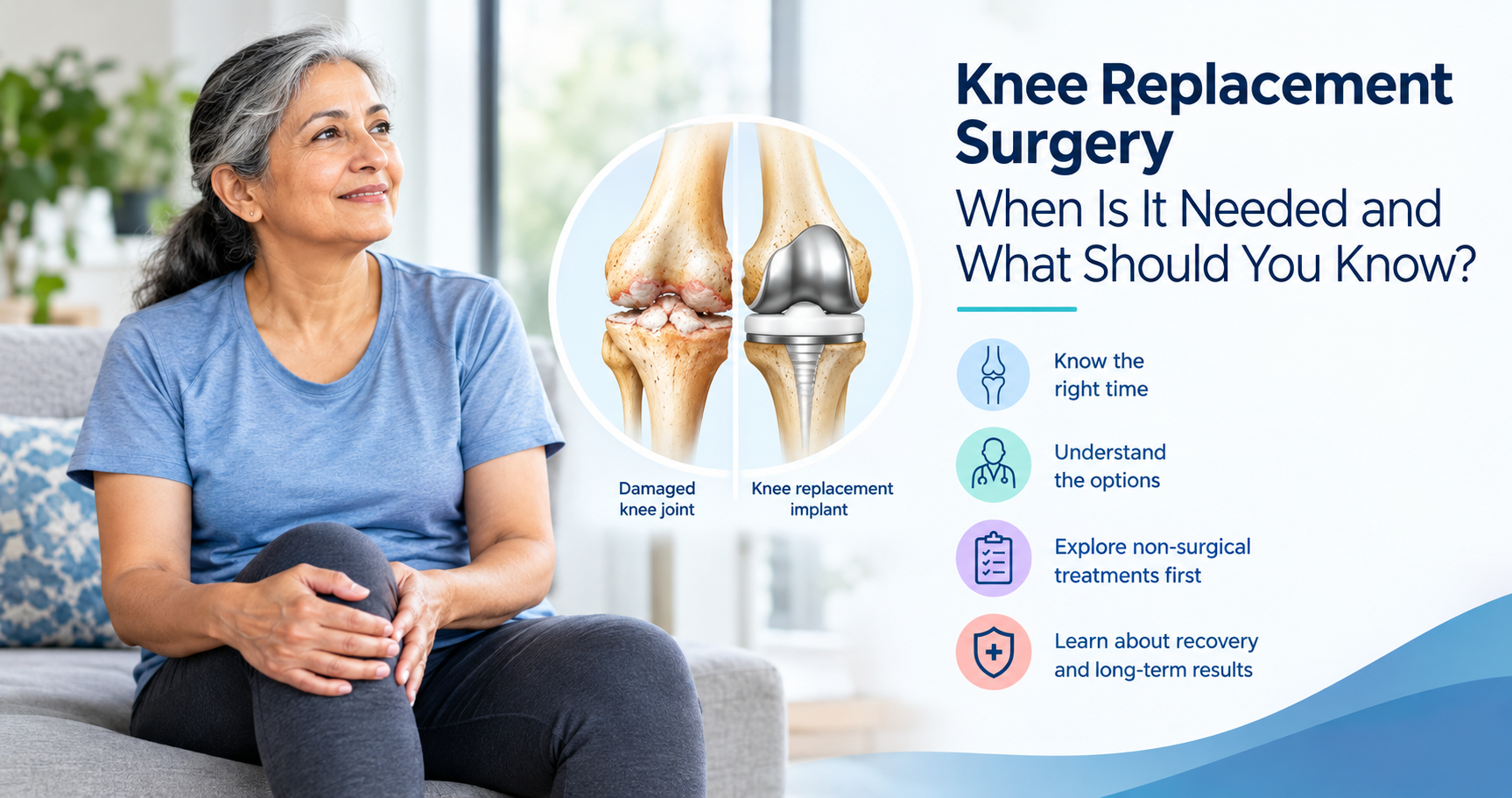
- Knee Replacement Surgery: When Is It Needed and What Should You Know?
- admin
- 0 Comments
Most people don’t decide to look into knee replacement in one day. It builds slowly. First the knee feels stiff after sitting for a while. Then you start avoiding stairs, skipping long walks, or planning your day around your knee. At some point you begin to wonder whether surgery is the next step.
There is no single sign that answers that question. Doctors look at how much your knee pain affects daily life, what your examination and scans show, and your overall health. This guide explains when knee replacement surgery is usually considered, how surgeons decide if it is right for you, and what you can try first.
In short: knee replacement is usually considered when severe arthritis or joint damage keeps causing pain, stiffness or difficulty moving, and exercise, medicines, weight management or injections have not helped enough. Age alone does not decide it, and neither does any one symptom.
What knee replacement surgery actually involves
People often say the knee joint is “replaced”, but resurfaced is closer to the truth. The surgeon removes worn cartilage and a thin layer of bone from the ends of the thigh bone and shin bone, then fits metal components that recreate the joint surface. A medical-grade plastic spacer sits between them so the knee glides smoothly. The underside of the kneecap may also be resurfaced.
In a total knee replacement, all the main surfaces of the joint are treated. In a partial knee replacement, only the damaged section is treated, which can suit some people whose arthritis is limited to one part of the knee and whose ligaments are healthy. Your surgeon decides which approach fits your knee after examining you and reviewing your scans.
Why knees reach this point
Most long-term knee pain comes from arthritis. Osteoarthritis is the most common type, a slow thinning of the cartilage that cushions the joint. It usually shows up after 50 but can appear earlier. Rheumatoid arthritis, where the immune system inflames the joint lining, and post-traumatic arthritis, which can follow a fracture or ligament injury, are the other major causes. As cartilage wears away, the bones rub against each other, and the result is pain, stiffness, swelling and sometimes a visible change in the shape of the leg.
When knee replacement is usually considered
Surgeons rarely look for one deciding symptom. They look at how much the knee limits your life and whether other treatment has stopped working. The American Academy of Orthopaedic Surgeons (AAOS) describes people who tend to benefit as those with:
- Severe pain or stiffness that limits everyday activities such as walking, climbing stairs and getting out of a chair, sometimes to the point of needing a cane or walker
- Moderate to severe knee pain at rest, including at night
- Long-lasting swelling and inflammation that do not settle with rest or medicines
- A knee that has bowed inward or outward
- Little improvement despite treatments such as anti-inflammatory medicines, injections or physiotherapy
The UK’s NICE guideline on osteoarthritis frames it in similar terms. Referral for joint replacement is worth considering when knee symptoms substantially affect quality of life and non-surgical treatment has not worked or is not suitable.
Notice what is missing from both descriptions. Neither depends on a particular age, and neither treats a scan as the whole story. Two people with similar X-rays can feel very differently, which is why the conversation always begins with how the knee affects your day.
Symptoms worth getting checked
You do not have to wait until the joint is badly damaged to see a specialist. An orthopaedic evaluation makes sense if:
- Knee pain has lasted several weeks and is not improving with rest and simple care
- Pain wakes you at night or bothers you even when you are sitting
- Swelling keeps returning
- The knee locks, catches or feels as though it might give way
- Stiffness is slowly increasing, or you can no longer fully straighten or bend the knee
- You have started avoiding stairs, longer walks or family outings because of your knee
An evaluation is not a commitment to surgery. Often it ends with a plan built around exercise, weight management and medicines. If your pain flares mainly in the rainy months, our guide to monsoon joint pain and knee pain explains what is usually temporary stiffness and what deserves a closer look.
Some symptoms should not wait. A knee that becomes hot, red and swollen, especially with fever, or sudden difficulty putting weight on the leg after a fall or twist, needs prompt medical attention. These can have causes other than arthritis.
How surgeons decide whether you are a good candidate
At a consultation, the surgeon takes a detailed history, checks how the knee moves, and assesses its stability, strength and the alignment of your leg. X-rays are reviewed, and sometimes blood tests or an MRI are added. Behind all of this, the surgeon is weighing a few practical questions:
- Do your symptoms and your scans tell the same story?
- Have you had a fair trial of non-surgical treatment?
- Is the damage confined to one part of the knee or spread throughout?
- Are other health conditions, such as diabetes, heart disease or kidney problems, well controlled? These can raise the risks of an elective operation, so they are usually addressed first.
- Are you ready for rehabilitation? Recovery takes regular exercise and some help at home for a few weeks.
Age and weight deserve a straight answer. AAOS states that there are no absolute age or weight restrictions for total knee replacement. Most patients are between 50 and 80, but surgeons assess each person individually. NICE advises that age, smoking, other health conditions or obesity should not, on their own, rule someone out of referral. That said, a healthier weight and well-controlled conditions generally make surgery safer and recovery smoother. At Zynova Shalby Hospital, the orthopaedic team can work alongside the Diabetes 360 clinic and cardiology department when a patient’s wider health needs attention before surgery.
What to try before surgery
Non-surgical treatment is not a box to tick. For some people it keeps symptoms manageable for years, and for everyone it is the foundation that any later surgery builds on.
NICE names two core treatments for osteoarthritis: therapeutic exercise, and weight management for people who are overweight. Exercise that strengthens the muscles around the knee helps even though it may feel sore at first. On weight, NICE notes that any loss is likely to help, and that losing about 10 percent of body weight is likely to be better than 5 percent.
Other non-surgical treatment options your doctor may discuss include:
- Anti-inflammatory gels applied to the knee, and oral pain medicines used carefully according to your health and other medicines
- Physiotherapy to improve strength and movement
- Walking aids, supportive footwear or braces
- Injections in selected cases
- Care from a rheumatologist if inflammatory arthritis is the cause, for which our rheumatology department can help
Relying on painkillers for months without a plan is not a good substitute. Regular use can carry risks for the stomach, kidneys and heart in some people, so it is worth reviewing with a doctor.
Total, partial and robotic-assisted knee replacement
Options differ in how much of the knee is treated and how the operation is planned and carried out. The orthopaedic department at Zynova Shalby Hospital performs both partial and total knee replacement, and the choice depends on where the arthritis is and how your ligaments and alignment look.
In robotic-assisted knee replacement, the surgeon uses a robotic arm to follow a plan built from a scan of your knee. The surgeon still performs the operation. The system helps keep bone preparation within the planned limits. You can read more in our explainer on what robotic surgery is and who it suits.
What does the evidence say? Meta-analyses of randomised trials consistently find better implant alignment accuracy with robotic assistance. Patient-reported function and complication rates, however, have generally been similar to conventional surgery. Whether better alignment leads to longer-lasting knees is still being studied, and results can vary with the robotic system and the surgeon’s experience. In practical terms, robotic assistance is a useful planning and precision tool, not a guarantee of a better outcome. Ask your surgeon whether it would change anything in your particular case.
What recovery and results look like
Knee replacement is a major operation, but it is also one of the most studied. AAOS reports that surgery usually takes one to two hours, most people can begin exercising the knee within hours, and most return to normal daily activities within 3 to 6 weeks. Driving is typically possible at around 4 to 6 weeks, once the knee bends enough and muscle control is reliable. More than 90 percent of modern total knee replacements are still working well 15 years after surgery. Serious complications such as deep infection occur in fewer than 2 percent of patients, and blood clots are among the more common problems, which is why prevention measures are routine.
Expectations matter too. AAOS points out that a knee replacement will not let you do more than you could before arthritis developed, and surgeons generally advise against high-impact activities such as running and jumping afterwards. Walking, swimming, cycling, golf and light hiking are realistic goals. Physiotherapy is as important as the operation itself, and our guide to exercises after knee replacement shows what rehabilitation involves.
Questions to ask your surgeon before you decide
- What is causing my knee pain, and how advanced is it?
- Have I tried enough non-surgical treatment, and is anything left worth trying?
- Would a partial or a total knee replacement suit me, and why?
- Given my other health conditions, what are my specific risks?
- How much experience does the surgeon have with the procedure being recommended?
- What will recovery look like week by week, and what help will I need at home?
- Would robotic assistance change my plan, and what is the evidence for someone like me?
- What happens if I choose to wait?
If you are comparing hospitals, our checklist on choosing an orthopaedic hospital in Mumbai can help you frame these conversations.
Getting an opinion in Mumbai
If you live in Mumbai or the eastern suburbs and want a clear view of where your knee stands, Zynova Shalby Hospital in Ghatkopar West is an NABH accredited, 100-bed hospital with an orthopaedics and joint replacement department and a dedicated joint clinic. You can meet the surgeons on our doctors page, and cashless insurance is accepted. To arrange an assessment, use the appointment page or call 022-68900000.
Frequently asked questions
When is knee replacement needed? It is usually considered when severe arthritis or joint damage causes pain, stiffness or loss of function that limits daily life, and non-surgical treatment has not helped enough. Your surgeon decides after an examination and a review of your scans.
Is there an age limit for knee replacement? No. AAOS notes there are no absolute age or weight restrictions. Most patients are between 50 and 80, but recommendations are based on pain and disability, not age.
Can I delay knee replacement? Waiting is reasonable while non-surgical care is still working. An evaluation does not commit you to surgery, and it gives you a clear picture of where your knee stands so you can plan.
Is knee replacement the only option for severe knee arthritis? No, but it is the established option when severe symptoms continue despite other treatment. Exercise, weight management, medicines, injections and supports come first for most people.
Is robotic knee replacement always better? No. Trials show better alignment accuracy, but patient-reported outcomes and complication rates are generally similar to conventional surgery. The surgeon’s experience and a sound care plan matter a great deal.
How long does a knee replacement last? According to AAOS, more than 90 percent of modern total knee replacements are still working well after 15 years. Longevity depends on activity, body weight, general health and follow-up care.
Leave a Comment